Explore cutting-edge technologies transforming every industry. Learn how to apply them straight from the most iconic leaders around the world on our top-rated interview series, ExtraMile by YourTechDiet. Each session delivers conversations packed with insights, perspectives, and success stories that make an impact.
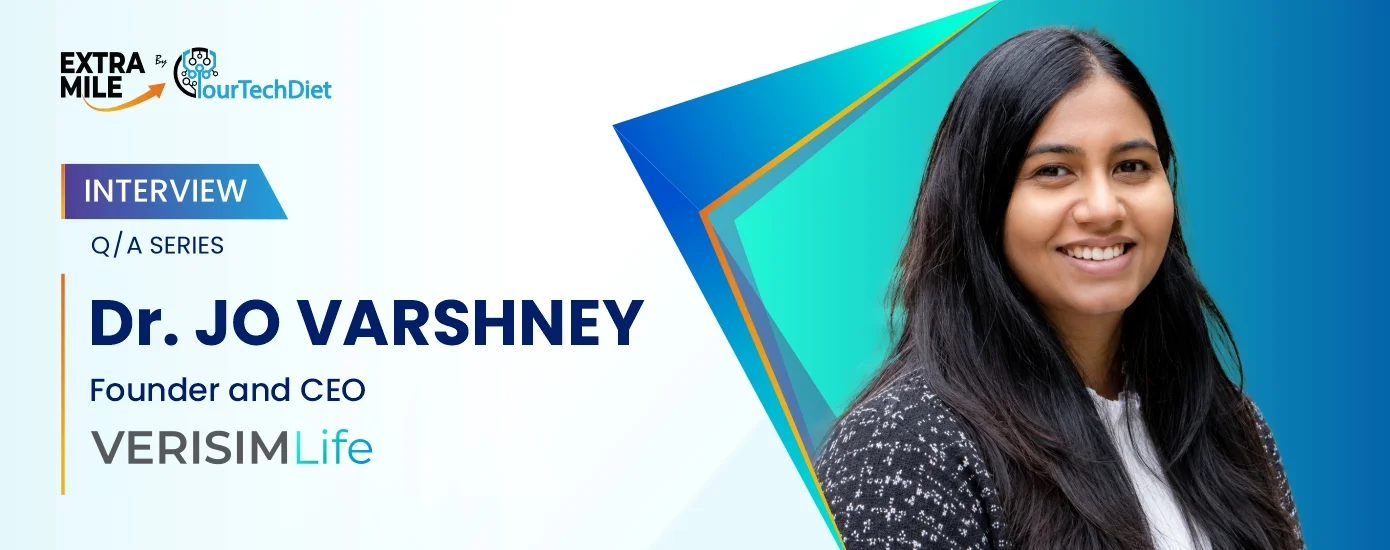
We’re thrilled to bring you our latest session, featuring Dr. Jo Varshney, Founder and CEO of VeriSIM Life, a biotechnology company focused on a persistent challenge in drug development: determining which drug candidates are most likely to translate successfully into humans.
Our spotlight leader, Dr. Varshney, is a veterinarian with a PhD in Comparative Oncology and Genomics. She invented BIOiSIM®, a first-of-its-kind AI-powered translational platform. Under her leadership, VeriSIM Life has secured more than $25 million in funding and worked with more than 20 pharmaceutical and biotechnology organizations.
Join the conversation as Dr. Jo shares her approach to AI-driven drug development, the BIOiSIM mechanistic AI platform, and the Phase 1 recognition for the “Combinatorial NAM for Endometriosis Drug Efficacy” submission.
She also highlights how VeriSIM Life engages with regulators and offers valuable advice to women and emerging scientists looking to build careers across science, technology, and research. Let’s dive in and unpack these insights!
Welcome, Dr. Jo! We’re pleased to have you here!
1. Your work is mainly focused on using translational AI to transform drug development while advancing the FDA’s 3Rs. What is your vision for using AI to make drug development efficient and personalized while reducing dependency on traditional animal testing?
Jo. A drug can look excellent in preclinical studies and still fail in patients. That gap between animal biology and human biology is the most expensive problem in our industry, and it is the reason I founded VeriSIM Life.
My vision is simple to state and hard to execute: generate human-relevant evidence early enough to change decisions. BIOiSIM® combines mechanistic biology, biosimulation, and explainable AI to evaluate efficacy, exposure, safety, dosing, formulation, and translational risk before a program consumes years and capital. Our Translational Index™ turns that into one interpretable measure, something close to a credit score for a drug asset. A team sees not just whether a candidate looks strong, but why, and where the uncertainty sits.
Personalization matters because there is no average patient. Genetics, disease biology, and physiology all shape whether a drug works and at what dose. Virtual human populations let us ask how a therapy performs across different patients instead of one idealized biology.
On the 3Rs, Replacement, Reduction, and Refinement, I am not claiming AI eliminates every animal study tomorrow. Better human-relevant evidence lets us replace studies where appropriate, skip the ones unlikely to teach us anything, and sharpen the ones we still need. The FDA’s April 2025 Roadmap to Reducing Animal Testing made that direction official policy. Animal biology is not human biology, and it should not be our only predictor of what happens in people.
2. VeriSIM Life leverages AI-driven bio simulation to assist pharmaceutical companies in enhancing drug development. From your perspective, what are some of the common setbacks in traditional drug development that AI can address?
Jo. A drug can look very promising preclinically and then behave very differently once it reaches patients.
In one of the largest academic analyses of clinical drug development, researchers evaluated more than 21,000 compounds and found that only 13.8% of drug development programs entering Phase I ultimately reached approval.¹ That means we are still discovering problems with efficacy, exposure, or safety after years of scientific work and significant investment.
There are a few reasons this keeps happening. Data are generated across assays, animal models, omics, and experimental platforms, but they are often analyzed independently rather than as one biological system. Traditional models also struggle to represent the biological variability we see in actual patients. And increasingly, AI can give you a prediction or a score, but a score alone does not tell a scientist why something may fail or what to do differently.
That is where I believe AI can have a much bigger impact. It should not simply predict whether a drug will work. It should help us understand why, connect evidence across different biological scales, quantify uncertainty, and determine whether the dose and exposure required for efficacy are realistically achievable in humans.
If we can answer those questions earlier, we can stop weak programs sooner and, equally importantly, understand what needs to change in promising ones. To me, that is the real opportunity for AI in drug development: not simply making the existing process faster, but helping us make better decisions before we reach the clinic. ¹ Wong CH, Siah KW, Lo AW. “Estimation of clinical trial success rates and related parameters.” Biostatistics. 2019;20(2):273–286. doi:10.1093/biostatistics/kxx069.
3. How does combining human-relevant data alongside BIOiSIM®, the mechanistic AI platform, improve the quantitative prediction of clinical efficacy and safety for endometriosis?
Jo. BIOiSIM, our mechanistic AI platform, does something no single model can: it connects different kinds of human-relevant evidence into one quantitative picture of how a drug will behave in a patient.
Endometriosis shows why that matters. The disease is heterogeneous, and no single preclinical model captures the biology patients actually have. Rely on one model and you miss the signals that decide whether a therapy works.
So, we do not treat any one technology as the answer. BIOiSIM serves as the translational layer that connects human relevant data and New Approach Methodologies, or NAMs, into a unified view of how a therapy is likely to behave in humans. The mechanistic layer is what makes those pieces work together. It connects experimental findings to pharmacology, exposure, disease biology, efficacy, and safety within a shared framework, so evidence from one method informs and constrains the others rather than simply sitting alongside them.
That allows us to move beyond whether a candidate produces a signal in a particular model. We can ask whether the exposure required for efficacy is achievable in humans, how response may vary across patients, and whether there is sufficient separation between an effective dose and a potentially toxic one.
For endometriosis, the question becomes very specific: which therapies are most likely to deliver meaningful clinical benefit, at an achievable human exposure, with an acceptable safety margin? That moves the work from observing preclinical outcomes to quantifying translational confidence before a candidate enters the clinic.
4. Your submission for “Combinatorial NAM for Endometriosis Drug Efficacy” has been selected as a Phase 1 winner in the NIH Complement-ARIE NAMs Reduction to Practice Challenge. What does this acknowledgment mean for VeriSIM Life’s mission to advance human-relevant, non-animal approaches to drug development?
Jo. What matters to me about this recognition is that NIH is asking the right question: not whether a new methodology is interesting scientifically, but whether it can actually be used to make better drug development decisions.
That is very aligned with how we have built VeriSIM Life. We have never been interested in developing technology that produces another prediction or another paper. The goal is to understand human biology earlier, reduce the dependence on animal models where they do not translate well, and give drug developers evidence they can actually act on.
For this challenge, we are applying that approach to endometriosis, where there is still a major need for better therapies and better ways to determine which candidates are most likely to work in patients. Our approach brings complementary human-relevant NAM data together through BIOiSIM so we can connect what we observe experimentally with exposure, efficacy, safety, and ultimately the likelihood of translation to humans.
Being selected as a Phase 1 winner is important because it gives us the opportunity to now put that approach to the test. The next step is not simply showing that the science works. It is demonstrating that the methodology is reproducible, useful, and capable of supporting real decisions about which therapies should move forward.
To me, that is where the field needs to go. Human-relevant methods will have impact when drug developers can trust them enough to make consequential decisions with them. That is the bar we are trying to meet.
5. As AI-driven and non-animal approaches are in the spotlight, how is VeriSIM Life engaging with regulators to showcase that these technologies can go above and beyond promise and become trusted, practical tools in drug development?
Jo. I think there is a lot of excitement right now around AI and non-animal approaches, but excitement is not the same as trust. Regulators need evidence that these methods work, that they are reproducible, and that we can explain why they reached a particular conclusion.
That is why we have chosen to engage directly. We have a research collaboration with scientists at the FDA’s National Center for Toxicological Research, where we are evaluating not only whether biologically grounded AI can identify risk, but whether it can help explain the biology behind that risk. For me, that second part is critical. A prediction becomes much more useful when a scientist or reviewer can interrogate what is driving it.
Our work through the NIH Complement-ARIE NAMs Reduction to Practice Challenge is another example. The goal is to move these approaches beyond proof of concept and demonstrate that they can generate evidence that is actually useful in drug development.
Ultimately, I do not think AI or NAMs earn regulatory acceptance because we say they are better. They earn it through transparent methods, rigorous validation, reproducibility, and performance on real problems. We want BIOiSIM to be measured against that standard.
6. You lead PulmoSIM Therapeutics that focuses on precision inhaled therapies for rare and life-threatening respiratory diseases. What inspired the creation of PulmoSIM and how does its work complement VeriSIM Life’s broader vision?
Jo. PulmoSIM came from a very simple conviction: if we believe BIOiSIM can make better drug development decisions, we should be willing to bet our own programs on it.
It is very different to build a platform and tell someone what it can do than to put your own capital, time, and therapeutic programs behind the decisions it makes. PulmoSIM gives us that opportunity. We use BIOiSIM the same way we ask our partners to use it: to understand human translation earlier, optimize dose and delivery, identify risk, and decide what is worth advancing.
We chose respiratory disease because the unmet need is enormous and because drug delivery and human translation are particularly important. Our lead program, PT001, is being developed for pulmonary hypertension and has received FDA Orphan Drug Designation. It remains investigational, but it has progressed because the evidence continued to support moving it forward.
For me, PulmoSIM is also an important part of VeriSIM Life’s identity. We are not technologists looking at drug development from the outside. We are drug developers ourselves. We make the same difficult decisions our partners make, including when to invest more, when to change direction, and when not to move a program forward.
That creates a very different level of accountability. If we are not willing to trust BIOiSIM with our own pipeline, we should not expect anyone else to trust it with theirs.
7. As a woman founder and a 100 Women in AI honoree, what advice would you like to share with women and emerging scientists looking to excel in technical and research careers?
Jo. My advice is to go deep in your field, but never let your training define the boundaries of what you are allowed to work on. I started as a veterinarian. I moved into genomics and comparative oncology, then computational biology and AI, and eventually became a founder. None of those transitions looked obvious when I was making them. But each one gave me a different way of looking at the same fundamental problem: why are we still so bad at predicting what will happen in a human before we get there?
When I started building VeriSIM Life, the idea of bringing AI and mechanistic modeling together was not an obvious category. There were plenty of moments when people did not understand why these approaches belonged together, or why someone with my background should be the person building it. I learned fairly quickly that you cannot spend all of your energy trying to convince every person in the room. You have to keep building until the evidence becomes harder to dismiss.
That has probably been one of the biggest lessons of my career. Credibility is accumulated. Sometimes very slowly. Especially when you are doing something that does not fit an established box.
So, ask the question other people are not asking. Be willing to cross disciplines. Stay close enough to the science that you can defend what you believe, but flexible enough to change your mind when the evidence tells you to.
And find people who will open doors for you, then do the same for someone behind you. I have benefited enormously from scientists, mentors, and communities who chose to give me an opportunity before the outcome was obvious. As you advance, you have a responsibility to create those opportunities for others too.
Check Out Our Other Informative Interviews: