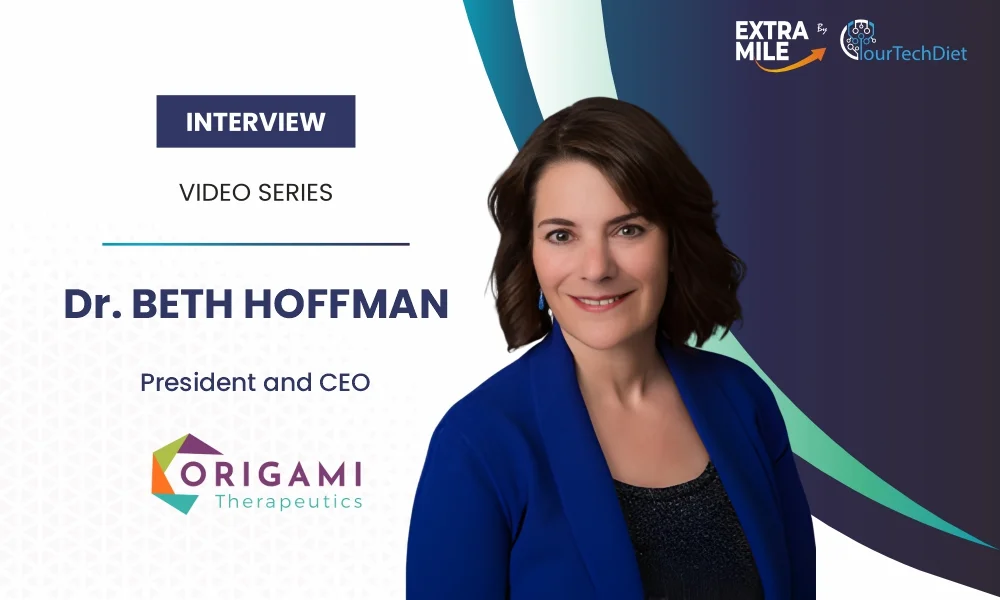
I’m your host Sannidhi, and today we’ll be discussing the therapeutics of neurodegenerative diseases and technology shaping drug discovery. To take this further. We’re glad to welcome Dr. Beth Hoffman, trailblazing Founder and CEO of Origami Therapeutics, a pioneering biopharmaceutical company developing small molecule protein degrders to target disease causing proteins in neurodegenerative disorders.
Our guest, Beth, is a Ph.D. holder with more than two decades of experience in CNS drug discovery. Let’s get into Beth Hoffman’s journey, her innovative approach into discovering curative medicines and neurodegenerative diseases, Origami’s lead programs, the technology shaping the future of drug discovery, and more without any delay. Welcome, Beth. We’re so delighted to host you.
What are your strong points? What are you able to do that differentiates you from others that’s going to make a difference and use that to select your disease indications. So, you know, most importantly is you want to know what you need to fix. So, what’s wrong? And so we rely very heavily on human genetics. And I think that’s really where a lot of the field is going, you know, in oncology and immunology and neurodegeneration.
And so if you understand the human genetics, you have an understanding of what causes the disease, not a correlation but what causes the disease. And that’s going to allow you to know what you need to fix pre clinically, what you need to measure and who to recruit and what to measure in the clinic. And if you don’t have both of those things settled out like what do you need to do pre clinically and how are you going to make the clinical trials successful then the rest is a huge challenge.
So, I think those are the most important pieces that lead to successful drug discovery.
Host: Okay, Thank you so much. That was truly a remarkable journey all together. Moving to the next question, how does Origami Therapeutics, protein degrader technology, good disease causing proteins? Exactly. And what makes this approach ideal when it comes to treating neurodegenerative diseases?
Beth: Yeah. So, I think everybody understands that neurodegenerative diseases are relatively complex and you see a lot of symptoms when you look at patients talk to their families. But what we decided to do was to look at a commonality across neurodegenerative diseases, which is misfolded proteins. And in many of these diseases, these misfolded proteins are toxic.
And so, we know what we need to get rid of. And so but even further, we want to get rid of the toxic forms of the protein, but spare the normal forms of these proteins in order to restore normal function and restore homeostasis. So, the goal here is not just go in with a hammer and whack everything out, but rather to be a bit more surgical about it and make sure that we’re leaving the patients to lead a normal life.
So, in other words, slow brain aging and extend health span.
Host: Okay, that’s fantastic. You’re truly targeting the most unseen issues altogether. Okay. So, moving on to the next question. What are the challenges faced by researchers in turning early age discoveries into a clinical proof-of-concept?
Beth: Yeah, So I think as most people appreciate drug discovery, there are a lot of things to optimize and you have to be aware of a number of different factors. But I think the three factors that I would say are most important to consider and optimize in order to get to clinical proof of concept is you need to use human disease models.
So, you need to show that whatever your therapy is works actually works in human cells. And that’s important because a rat isn’t a in a mouse and a dog are not human beings. And that’s where the translation what people talk about is translation to the clinic often falls short. The other piece is that, of course your therapeutic needs to reach the organ of interest for disease.
And a lot of people talk about, you know, PK, PK PD, target engagement and downstream pharmacodynamic effects. That’s all about you get to the organ of interest or organs and do you do what you need to do. And then thirdly, the really critical piece is to make sure you have a margin of safety between what dose should be efficacious and toxicity.
And that allows you then to be able to really explore what dose will be effective in clinical trials for human beings.
Host: Okay. That was truly a very, very helpful advice. Thank you so much. Moving on to the next question. How is the collaboration between Origami Therapeutics and Ipsen crucial for advancing treatments of rare neurodegenerative diseases?
Beth: Yeah. So first I’ll just say that we are just so thrilled for this collaboration. And while we’re just getting started, I think Ipsen has already proved to be an, you know, an outstanding partner. So, the crux of this is really Origami’s expertise on the preclinical side, together with Ibsen’s expertise in clinical development and commercialization. And I think that’s really going to help us by putting our heads together as two organizations, really help us focus on progressing neurodegenerative disease therapeutics into the clinic and available to patients.
The other side of that is first is validation for what we’re doing and how we’re doing it and the quality of our data. But also this allows us to focus on our next diseases and to build our pipeline. So, all in all, this is really, you know, huge for Origami.
Host: Yeah, truly collaborations can actually be a true catalyst in the process. And congratulations for the collaboration.
Beth: Thank you.
Host: Moving ahead, why did Origami particularly choose Huntington’s disease as the initial point of its therapeutic research?
Beth: Thank you so much for this question. So, I get this question often because it’s not what people think of when they think of neurodegeneration. Of course, think of Alzheimer’s and Parkinson’s and ALS. Actually, Huntington’s disease is a much larger population of patients than ALS. So, the importance here is what I kind of what I’ve already mentioned, which is you need to know what to fix.
And Huntington’s disease is caused by a mutation in a single gene. If you have this mutation, eventually you’ll get Huntington’s disease. If you don’t have that mutation, you might get some other form of disease, but you won’t get Huntington’s disease. So, what that allows us to do is we know what causes the disease, so we know what we need to fix.
And in this case, this was a toxic mutant misfolded proteins, as I’ve mentioned. But then we also know who to recruit and we know what to measure. And the beauty of some of these monogenic diseases is that there are usually natural history studies. So, we know a fair amount about how the disease progresses. And there’s also a registry of patients.
And so all of this helps us know who to recruit and what to measure in the clinic. So that’s really kind of where we started the interview in any case, which is you want to know what to fix and then what to measure. And so Huntington’s in particular is in neurodegeneration what you might consider low hanging fruit.
Host: Right? I’m sure your work is creating a real impact for all of these patients. Moving ahead, Origami focuses on lead programs to cure numerous neurological disorders such as Parkinson’s disease, Alzheimer’s disease, Huntington’s disease, and amyotrophic lateral sclerosis. How are these complicated conditions prioritized in research?
Beth: Yeah, so I’ve kind of touched on this already in that, you know, we go after we looked at our technology, which is small molecules that can change how proteins fold. And together with that, the human genetics. And so as I already mentioned about Huntington’s disease, this is a fairly homogeneous population of patients that’s differentiated a bit by Alzheimer’s an Parkinson’s, where more and even ALS, where multiple different mutations cause the disease, as well as having a fairly large group of idiopathic causes, meaning simply we don’t really know what causes the disease.
So, it’s a little harder to know what’s really going to be successful. So, we prioritized Huntington’s disease. Next on our list is frontotemporal dementia with around town mutation. So that’s another protein that’s important in the cell. And so basically what we go after or where we actually know what the genetic causes and you might say, well, what about everybody else?
And of course we’re concerned about everybody else who has other neurodegenerative diseases. But I think what we’re learning already from our work in Huntington’s disease is the fact that we are learning a lot about the in this case, protein degradation pathways that that occur in cells and cause neurodegenerative disease. And so as a result, we expect that a lot of our learnings will carry over to help us address additional indications.
Host: Sure. That’s really great. Moving ahead, what were the scientific challenges in the way when clinically rolling out the cystic fibrosis therapies like Kalydeco, Orkambi, Symdeko, and Trikafta during your time at Vertex Pharmaceuticals?
Beth: Yeah, thanks for that question. So you know, what people may not know is that it really was the insights from these CF programs that led me to plot to leverage learnings from the CF programs and start Origami Therapeutics, focusing on neurodegenerative diseases, at least initially. So, I think the keys here really were our ability to use human disease models, which we had to do.
There were no animal models for cystic fibrosis and that allowed us to translate to the clinic and include. The other factor was the design of the clinical trials. And this I try to emphasize to people is, you know, you can’t measure one thing. Of course you have to have a primary measure. And the expectation is that will be a registrational measure.
But you need to have a number of secondary measures and you need to be able to understand who are responders and who are non-responders. And that’s all very important so that you that’s how you really leverage the clinical trial and your therapeutic understand more about the disease and the patient populations. So the other piece that we were really fortunate to be able to do using Human cells and these are human lung epithelial cells, was we were able to actually achieve a label expansion based on in vitro data with different mutations so that we could cover the large number of mutations that occur in cystic fibrosis.
This was the first time that the FDA actually approved a label expansion using in vitro data. So that was really, you know, very rewarding and very exciting.
Host: That sounds truly remarkable. Dr. Beth It’s truly inspiring for all the people aspiring to be there. Okay. So, as we move on to the last but the most important question, what technologies stand in the next wave of drug discovery and what role AI would play in this regard?
Beth: Yeah, thanks for that question. I know everybody is very interested in AI and how to use it, and I think, you know, there are a couple of principles. First, it’s human first, and that’s at Origami. We put human first, and that’s the emphasis on using human systems. Furthermore, it’s also very important to use primary cells, and that’s because the cell lines, the recombinant cell lines that people use are fine for some initial screening, but all of the cell pathways have been modified in order for these cells to survive in a dish forever.
Basically. The second piece is phenotype first. So in other words, rather than picking a target, we go after the effect that we want to see in the clinic. So as an example for Huntington’s disease, we wanted to see that we got rid of the mutant Huntington protein but spared the normal or wild type protein. And so that was a phenotype on which we screened and how we found a series of chemical scaffolds.
And so that’s really, I think, phenotypic screening will be making a comeback given all of the advances in omics in particular proteomics, in order to identify the target. The third piece I’d say is patient stratification. And we basically imposed stratification on ourselves here at Origami by picking Huntington’s disease. But for things like Parkinson’s disease and Alzheimer’s disease will want to be able to stratify the patients.
So, human genetics is one piece, but also that’s why I emphasized in the previous questions the issue of being able to identify responders and non-responders. So, in all of these pieces, AI plays a critical part. So a number of firms have cropped up looking at clinical twins to try to predict the outcome. We’ve used it extensively in understanding our mechanism of action.
So, we talk, people talk about genomics, so transcriptomics, proteomics, metabolomics, lots of omics, high content imaging. And so we use AI to look at all of that and tell us what do we think the pathway looks like? What are the commonalities and how do we think that’s restoring normal function as well? As you know, that also helps us identify potential biomarkers and so I think AI plays the key to many technologies and AI is no exception is how are you going to use it and how does that help you understand and develop further hypotheses, or in this case, you know, stratify patients, for instance?
And so a lot of what’s being done now in single cell omics as well is data heavy technologies. And particularly I see that being used in human disease models to help us pick the best optimize and pick the best compounds that have the that are most effective in normalizing function and homeostasis. And so I think there’s a huge role, but obviously it has to be applied appropriately.
Host: Because as you said, very quickly, human always comes first. And that was truly very insightful coming from you. With that, we come to the end of this enlightening interview. Thank you so much, Dr. Beth, for sharing your incredible journey and insights in the future of therapeutic innovation. Your work at Origami Therapeutics is driving an exceptional approach to discovering curative medicines for neurodegenerative diseases.
Alongside a big thank you to our audience for tuning in to ExtraMile by YourTechDiet. I’m your host, Sannidhi, signing off for the day. Stay tuned for more such tech updates and insightful conversation with industry leaders shaping tomorrow’s tech science and innovation. Thank you so much for joining us.
Beth: Thank you so much.