
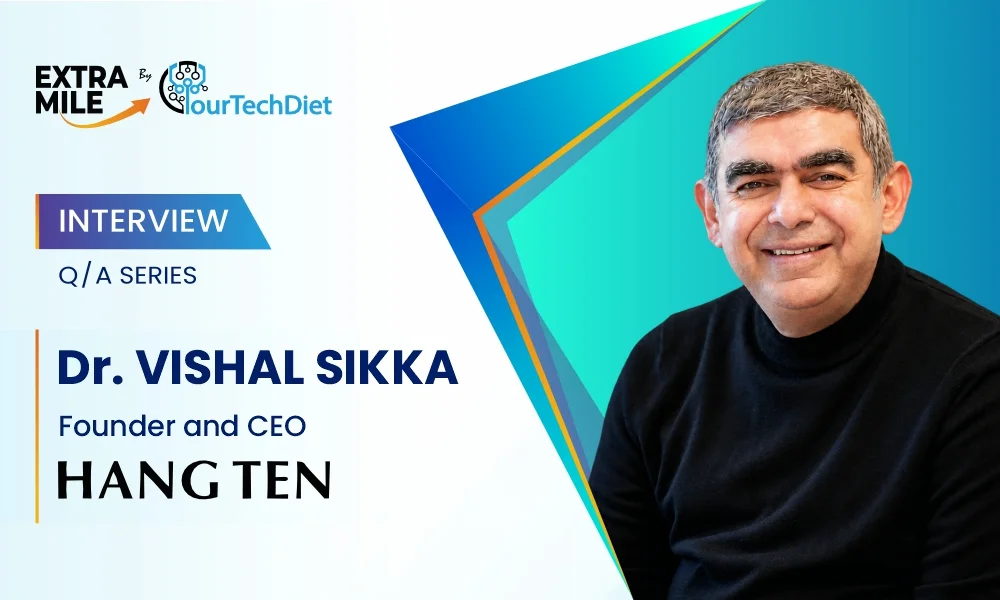
Presenting conversations with industry pioneers, innovators, and C-suite leaders about the purpose and power of technology, only with ExtraMile by YourTechDiet. Our interview series brings insights that matter most in today’s competitive world. For our exclusive session, we’re delighted to have Dr. Vishal Sikka, Founder and CEO of Hang Ten Systems, an enterprise AI services company helping organizations put AI to work in the software they depend on.
Our guest, Vishal, brings extensive tech leadership experience, including senior roles at SAP and Infosys. He has a practical understanding of enterprise software, AI innovation, and digital transformation.
In this conversation, Vishal discusses his career journey, the challenges organizations face in adopting AI, the importance of enterprise AI adoption, and human oversight in AI-powered systems. He also shares insights on the company’s agentic platform Hobie, and his perspective on sound judgment when deploying AI.
Dive in now and see how enterprises can unlock the full potential of AI to transform into meaningful business outcomes.
1. From leading as an executive board member at SAP to CEO of Infosys, and later taking on board positions at BMW, GSK, and Oracle, your career journey is influential. What are some of the most significant technology shifts you’ve witnessed during that period?
Vishal. Real-time computing was a very significant shift. At SAP, our work on HANA changed the relationship between a business and its information. You could analyze what was happening as transactions occurred, and that opened up entirely different ways of making decisions. Cloud computing then changed how software could be delivered and how quickly companies could experiment.
AI is now changing the creation of software itself. People can express what they want to accomplish in ordinary language and have a system help them build it. That is an extraordinary development.
Across these shifts, I have seen how much depends on people’s willingness to rethink their work. A new technical capability can arrive quite suddenly. Understanding what to do with it, and changing an organization around it, takes considerably more effort.
2. What inspired you to launch Hang Ten Systems, and what strategic gap did you see in the enterprise AI market that you aimed to address with your new venture?
Vishal. I kept seeing a very uneven picture. Some people were doing extraordinary things with AI, accomplishing work in minutes that would previously have taken enormous effort. Many enterprises were struggling to get meaningful value from the same technology, sometimes introducing more complexity and risk along the way.
That gap is what led us to build Hang Ten. Enterprises need people who understand both the technology and the systems their businesses depend on. They need help deciding where to begin, building something that works, and taking responsibility for it as their needs change.
The name comes from surfing. To hang ten requires a real mastery of the wave. That is our ambition for customers. We want to help them become capable of doing things with AI that they could not have contemplated before.
3. AI is here to accelerate work, but poor use of AI can cause harm. From your viewpoint, what safeguards or principles should enterprises put in place to ensure AI creates value rather than introducing new risks?
Vishal. I would start with a clear understanding of what the system is being asked to do and the consequences of getting it wrong. That should determine how you test it, what information it can access, and which actions require human approval.
Enterprises need to evaluate AI against their own data and actual working conditions, including the exceptions and awkward cases. They also need a way to trace an answer to its sources, investigate a failure, and stop the system when necessary. Those responsibilities continue as the models and underlying systems change.
There must be someone accountable for the result. People need enough visibility and understanding to challenge what the AI produces. A confident answer is very easy to generate. Establishing that it is appropriate for a particular business decision requires much more care.
4. Your startup has raised $85 million in seed funding from top-tier VC’s including Mayfield leading the round and strategic investment from Aramco Ventures. What do these strong investors mean for Hang Ten Systems?
Vishal. Navin and I have known each other since our Stanford days, so there is a long relationship behind Mayfield’s investment. Mayfield backed us from inception and understood the opportunity we saw in changing how enterprise software gets built and delivered.
Aramco Ventures brings a valuable perspective on the demands of large industrial organizations. When you are working at that scale, reliability, integration and the economics of implementation matter enormously.
Having investors who understand those realities gives us a strong foundation. The capital allows us to build the team, develop our platform and take on more customer work. I also see their backing as a responsibility. We have to earn that confidence through the quality of what we deliver.
5. Your startup is already working with the world’s largest companies such as Siemens Energy and Fresenius on AI-native project delivery. Does this early engagement give an idea about the challenges enterprises face when adopting AI, and how can Hang Ten address them more effectively?
Vishal. Yes. Working with companies such as Siemens Energy and Fresenius makes the practical requirements very clear. These businesses have accumulated decades of systems, processes and specialized knowledge. Any new capability has to work within that reality.
Even a seemingly straightforward request can involve different definitions of the same business term, information spread across several systems, and restrictions on who can access it. Generating the code is one part of solving that problem.
Our approach brings experienced engineers alongside the customer’s team, with a specific business outcome to deliver. The people doing the work need to understand why a process exists and what depends on it. Starting with a defined scope also gives the customer a way to assess the result before expanding the work.
6. Could you share insights about your agentic AI platform Hobie? What makes it different from other AI development platforms available today?
Vishal. Hobie is the platform behind our enterprise delivery work. It combines reusable AI capabilities with knowledge of the customer’s systems and business.
For example, an agent answering a question about revenue needs to understand how that company defines revenue, which systems contain the relevant information, and what the person asking is allowed to see. Hobie makes that business context explicit and inspectable. It can query information where it already lives and trace answers back to the underlying data.
We also build evaluation and refinement into the process, so agents can be tested as the environment changes. That combination is central to our approach. Our engineers use Hobie to build capabilities that can be maintained and adapted through the life of an enterprise program.
7. Having AI expertise alone isn’t enough today; the judgment applying it effectively is a must. What does “good judgement” look like actually when deploying AI in critical enterprise environments
Vishal. Good judgment begins with understanding the consequences of a decision. Asking AI to suggest an explanation for a discrepancy is very different from authorizing it to change the underlying records. The level of evidence and supervision should reflect that difference.
It also means recognizing when the problem is poorly defined. A team may ask for an AI agent when the real difficulty is inconsistent data or a process nobody fully understands. Automating that confusion can make it much harder to resolve.
The people deploying these systems need to know when to question an answer, when to involve a domain expert, and when a simpler approach will serve the business well. As AI makes implementation faster, the quality of those decisions becomes increasingly important.
8. What are the transformative possibilities you believe AI can unlock for enterprises in the coming years? How will Hang Ten Systems prepare to stay ahead
Vishal. There is an enormous backlog of things enterprises would like to do but have never been able to justify because of the cost or time involved. AI can change those calculations. A company can build software around a specialized business need and keep adapting it as that need evolves.
I am particularly interested in what happens when people with deep knowledge of a business can participate more directly in creating its software. Their ideas have often had to wait behind long development queues. Giving those people greater ability to act could produce some very interesting inventions.
For Hang Ten, staying ahead means continuing to learn through delivery. We will keep developing Hobie, investing in people who understand difficult enterprise problems, and evaluating advances in AI against what they enable customers to accomplish.
Check Out Our Other Informative Interviews: