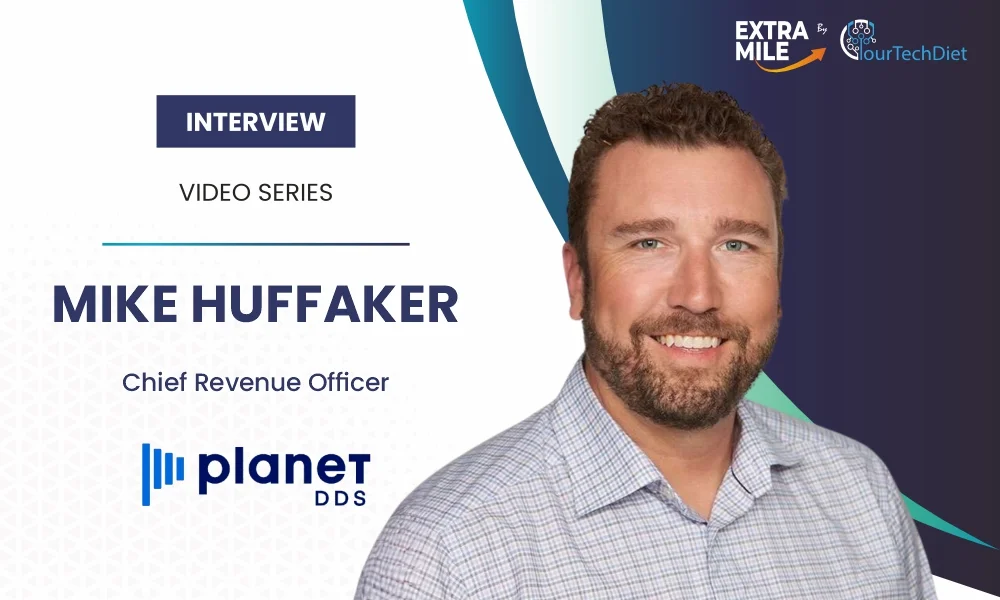
To lead the discussion, we are absolutely thrilled to welcome Mike Huffaker, the Chief Revenue Officer of Planet DDS, the company empowering dental organizations to grow smarter, scale faster, and deliver exceptional care while increasing the long-term value to their business.
Our featured guest, Mike, brings nearly two decades of sales leadership experience and a sharp lens on where the dental tech is headed next. So, let’s get into the conversation as Mike shares his inspiring journey, the go-to-market strategy, the power of DentalOS, the role of AI in dentistry, and what it truly make to build high-performance dental centers.
Welcome to the session, Mike. We’ve been looking forward to this one.
And in addition to coming in to learn and understand the industry and learn from the two folks that I had at the time, it was a very roll up your sleeves sort of environment for me. I needed to build out all of our processes in Salesforce. We needed to hire people, we needed to expand the organization, we needed to identify what our processes looked like from a go-to-market motion.
But I was definitely very, very close to the front lines and to customers, and I even sold some deals myself. I thought it was important to establish and build credibility. As I’ve moved up within the organization, as the organization has grown below me and transitioned into the CRO role, where I now oversee sales, account management, and marketing, it’s been a challenge to let go of some of the things that I was doing before and reallocate my attentions to where I need to focus now. And so once you get into an executive level position, you have an obligation to the organization, to the business, to the company, to set strategy, to set the vision over your particular organization and to collaborate with your fellow executives on what’s going to be best for how the company moves forward. In order to do that, you need to become much better at delegating. You need to understand where high-value activities you should be focusing on versus those that it’s time to allow somebody else to take the mantle and, to do that. And so my leadership style has changed over time in that you get to the point where you shouldn’t necessarily have anything to prove yourself, and you should be enabling those that work within your organization to showcase their abilities, to help them continue to grow in their career. And the only way you can do that is by giving them opportunities to do things and to place your trust in them. And so, I would say at the outset of my career, I was very concerned about my own position within organizations.
And now I’m very concerned about the positions of the folks that work with me and ensuring that they show in the best way possible their success as fosters.
Host: Yeah, that has been a great journey, I must say. And the evolution has been real. Next up, Planet DDS says it makes DSOs worth more.
So how do you actually prove that and what do the numbers look like?
Mike: Yeah, so in the DSO space, which are Dental Service Organizations, for those that aren’t aware, they are groups of dental practices. Historically, the dental industry has been predominantly independently owned practices or solo practices. Over the past 10 to 15 years, there’s been a real acceleration in the consolidation of dental practices into larger organizations.
And so, when looking at valuations for groups of dental practices, they can’t all operate as if they are independent organizations in a multitude of different methods. And valuation for DSO is very much tied to EBITDA production. And so what we offer is a standardized platform that allows people to put the correct operations in place to maximize the benefit of the patient and also maximize the success of the business, thereby leading to increased EBITDA, standardization operations and consistency and growth, which is another very important piece.
And so, if you’re able to add to the EBITDA, if you’re able to create consistency and growth and you’re able to allow somebody to have the foundation to standardize their organization, they become a much more attractive asset for investment. And that’s how we make DSOs worth more.
Host: Yeah, that was absolutely amazing. And it is quite impressive how Planet DDS is prioritizing people as well as growth.
Mike: Absolutely!
Host: So, moving further, in a tight knit and highly competitive market like DSOs, what actually makes a GTM strategy that wins versus one that makes noise?
Mike: Yeah, so our foundational principle within the revenue organization is that we sell and market with integrity. And when you are selling into enterprise organizations, there’s not a lot of room for fluff or over-promising, for under-delivering, and you only have one reputation. And so, you need to ensure that your perception in the marketplace is one of being a good partner with a good product, a good solution, and people that you want to work with.
And especially in the age of AI, where so much content and everything else can be created so quickly, still having that human relational touch, the enterprise side of a go-to-market motion is incredibly important. It’s a long game in many cases. We have some deals that will take multiple years to close.
Sometimes it’ll be just two or three months. But we need to ensure that when that particular organization, that DSO, is ready to make a change when the pieces have fallen into place where it’s no longer tenable for them to be where they are, and they recognize that they need to install a new core system of record, mission-critical software, we need to make sure they know who we are and that we have been in front of them. So, the motion for go-to-market includes a multitude of touch points from many people within the organization over an extended period of time.
We need to be known so that when they are ready, we’re ready to serve them. And it needs to be where we are providing value to them. As part of why we launched the podcast, we have a newsletter.
We released an industry report. We speak on stages all across the country at different shows and events. Not as a sales motion, but as a brand perception motion so that people are aware of who we are and want to work with us when the time is right.
Host: Yeah, absolutely. Value is served the best when we and our client know each other’s goal the best.
Mike: Absolutely. I agree.
Host: Moving to the next question, the Dental Economist show focuses on everything around the business of dentistry. So, what are some recurring insights you have observed from industry leaders?
Mike: Well, dental is a hard industry. There’s a lot of challenges with it. Change management is really difficult at scale.
So, just the framework and organization of dentistry and particularly DSOs, where you have dentist leaders in individual locations, but then you have the corporate support organization that is there to help install new processes and to ensure growth of the business creates a challenging environment where you have unique cultures and all these different practices that you need to navigate in order to try to gain alignment on what the path forward should be for creating excellent outcomes for your patients.
And so, installing operational rigor and discipline is a common theme. Very challenging. Striking the balance between clinical autonomy, which is the decision making of the dentists when they are with their patient in the chair, versus the needs of the business, which can result in implementation of new technologies or tools within the clinical experience for a patient and how you gain buy-in across your organization in order to execute on that.
Those are all recurring themes, as well as driving a positive company culture that we discuss frequently on the podcast.
Host: Yeah, that was impressive. Hearing from the industry leaders about the dentistry trends must be a great one.
Moving further, from your perspective, what’s your view on integrating AI into your current revenue strategy and the future of dental practice management?
Mike: So, on the revenue strategy, it’s non-negotiable. I think that companies are wide, have a lot of variances, and the maturity that they have with AI adoption at this point. It’s often very fragmented and not cohesively organized for teams to be able to leverage.
We have implemented a number of off-the-shelf type tools like Gong, you know, we have Salesforce, we use a tool called Fixer for inbox management, but then we also have Claude across the organization. And the ability to research accounts, to customize communications, to understand who we need to reach out to and when, to look at intent data, to prep for calls that are going to take place and ensure that you’re dialing in on exactly that which is important to the prospect that you’re working with and not wasting their time or yours and showcasing things that are of no import. All of those are made tremendously easier through leveraging AI tools.
We have a lot of different projects, skills, and approaches to doing that within our revenue org. And at some point, in the not-too-distant future, for the more sophisticated go-to-market motions, every single sales executive will have their own host of assistants. You’ll have the call prep assistant, you’ll have the demo prep assistant, you’ll have the account research assistant, and you’ll have the prospect identifier assistant.
And all of those things that previously would take somebody an hour here, two hours here, maybe even a week. A presentation builder’s assistant, say an assistant, you can swap that out with agent, but that is the direction that is going, and we’re getting close to realizing that type of efficiency within our organization. On the dental side with the product, it is really an agentic story.
There’s a lot of voice agents out in the marketplace now. There’s agents that will call and schedule appointments, that will handle rescheduling, that will act as an AI receptionist. There’s AI technology within the software to translate voice to usable functions within the workflow for Perio charting or just charting in general or taking progress notes.
And then on the RCM side, there’s claim scrubbing; there’s auto insurance verification. So, it’s a whole new world that’s taking place both in our go-to-market organization and then with our product for our customers.
Host: Yeah, very true. It is fascinating to learn how diverse industries are turning toward AI, and even revenue strategists and dentistry. So yeah, moving further,
In what ways does DentalOS simplify day-to-day clinical and business operations and how does it support long-term growth for dental organizations?
Mike: Yeah, so it’s the foundation or the platform for everything that happens within a dental practice and everything that happens within the corporate organization that sits on top. So, it offers you security, stability, and availability. It offers you clean, consistent datasets that you can run off of, manages all of your in-office workflows, and it integrates with whatever tool you’re looking to leverage to best run your business so that you have flexibility and you’ve effectively future-proof your organization’s tech stack.
Through all of that, it creates consistent business outcomes for our customers and for their practices and for their patients, which ultimately leads to long-term growth.
Host: Yeah, exactly. That was a powerful description of DentalOS. So, on that note, as a senior sales leader, what’s your definition of a high-performing sales culture in today’s SaaS environment?
Mike: Sure. So, for a long time in the SaaS world, you would measure productivity by a comp-to-revenue ratio. How much did they book in new business divided by how much you pay them for those bookings, both from their base salary and their commissions.
And depending on the segment or the market that you were in, if it was a lower-end or mid-market, you could expect or see somewhere in like a four to six range. If it was enterprise, maybe you were looking at seven to nine. And as we become more efficient and effective through leveraging AI, you start to expect to see those productivity metrics increase, where potentially a rep has $200,000 on-target earnings before you would expect that they would need to book between 800 and 1.2 million. And now they’ll be booking 1.5 or 1.7. So, it offers and affords an opportunity to not only pay the people within the organization more, but also to have more production per person. And as far as what a successful sales culture looks like to me, I think I have some somewhat unique viewpoints on that. We’ve created something we call the Revenue Team Principles.
It is an addendum to our company’s values. Every single week, when we do our weekly, what we call Monday morning Ignite meeting with the entire sales marketing and account management organization, we cover different principles with examples of how they’re being showcased in real life in our day-to-day work with our customers. And I mentioned one of them, which was we sell and market with integrity.
We really hold true to that. We also have one that says our team is competitive and collaborative. If somebody is a great salesperson, but they won’t work or share their learnings with others, they don’t need to work here.
And I know that’s a little counter towards what other folks in other organizations be like. I don’t care as long as they’re getting the bookings, and they’re doing great. They don’t need to help other people while I do care.
And you do need to help other people. And so, we create a relatively humble environment across our organization where still people want to be the best, but they don’t try to hide secrets about how they got there. And their real superpower for the ones that are at the top of the hill is that they not only can share what they know, but they can still be the best.
We go a little bit further, and we have a principle that says negative and toxic behavior and is never worth the revenue they generate. Another way of thinking about that is our no assholes rule. So, you can’t be a jerk if you are, and if you are self-serving and if you are full of drama or gossip or negativity, you know, you can find a job somewhere.
It just can’t be here. And then we also believe strongly in pouring into our people, whether they stay with us or they go pursue other opportunities. If they outgrow whatever we have with them, we wish them the best and we hope that they have a really, really great future career at wherever they end up going.
We hope that we’re the ones that are able to support and foster and nourish their growth within this organization. But my desire is that if you leave Planet DDS, if you’ve made the decision to do so, you always think of your time here fondly because we didn’t have negative toxic behavior. We were collaborative, competitive, and we sell to market with integrity.
Host: Yeah, that was amazing, Mike. So last but not least, as dental organizations continue to scale, what are the key innovations and trends that will empower clinicians and staff while maintaining operational efficiency?
Mike: I probably don’t have a perfect answer for this one because it really depends on what a particular organization is struggling with. Inside the dental space, there’s so many different levers that can be pulled. One practice may have a no-show or appointment cancellation issue.
Another practice may have an issue where they’re presenting treatment; patients are accepting the treatment, but then patients aren’t completing the treatment. So, there’s a follow-through issue there. Another practice may have an issue with new patient acquisition, where they’re not acquiring a sufficient amount of new patients to replace the ones that leave and also to ensure that the business grows.
All of those have different solutions that can be implemented into the organization, and I caution people against trying to do everything at once. You need to identify what are the most important problems that you’re looking to solve. What is your real pain that you need a solution for, and then methodically and thoroughly implement it with a high level of change management.
But self-scheduling on the appointments, scheduling agents, reminder and recall agents, radiographic AI, RCM, automated verifications for insurance and claim submissions, and claim scrubbing. All of these things play a part, and they’re available in various forms today. And those are, if they are integrated well into your core system of record, where you’re not creating a cognitive burden on the workload of the staff and the workflows of the staff, that’s where you have the opportunity to really maintain operational efficiency.
You have to be very strategic in your approach for how you go about it and ensure that you get the buy-in from everybody who’s going to touch it within your organization for it to be successful.
Host: Yeah, absolutely. The future of dental enterprise is truly promising, and Planet DDS is right there at the center of that shift and a strategic approach. So that’s a wrap for today’s discussion, Mike.
Thank you so much for being with us today. Your journey and candid perspectives on dental industry and your vision for where dental enterprise is heading toward is truly noteworthy. This conversation has been genuinely thought-provoking for us.
Thank you so much.
Mike: Yeah, thank you for having me. Very much appreciated it.
Host: Yeah. A heartfelt thank you to our audience for staying tuned with ExtraMile by YourTechDiet. Don’t miss out on further conversations straight with another industry leaders shaping the future of tech, business, and beyond.
Until next time, see you.