
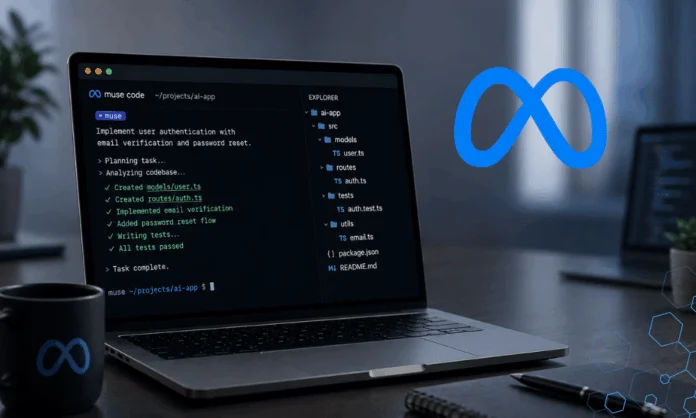
Meta has entered the AI coding assistant race with the introduction of Muse Code. It is a terminal-based coding agent created to help developers manage complex software engineering tasks across large codebases. Officially launched on August 5, 2026, as a beta release, the agent is powered by Meta’s latest Muse Spark 1.2 model. The step marks Meta’s most significant push into AI-assisted software development. The latest coding agent is set to compete with offerings from OpenAI and Anthropic.
Mark Zuckerberg, Meta’s CEO, posted on X, “Releasing Muse Code in beta today. It’s a terminal coding agent that takes on complete software engineering tasks across large repos: planning changes, writing code, validating the results. Powered by Muse Spark 1.2, a coding-focused model update.”
The announcement comes as coding agents become capable of handling more than simple code generation. Muse Code is designed to understand an entire repository, plan changes, write code, execute commands, run validations, and verify results with minimal developer intervention instead of only suggesting snippets. As per Meta, the agent is built for long-running engineering workflows that often involve multiple interconnected files and dependencies.
Muse Code Addresses Large Codebases and Long Engineering Tasks
Muse Code operates directly from the terminal and is optimized for repository-scale development. Developers can assign high-level software engineering tasks, while the agent determines the required code changes, performs edits, and validates whether the implementation works as expected.
A key feature is its ability to split larger assignments into multiple sub-agents that work simultaneously in isolated workspaces. The parallel execution approach allows different components of a project to be developed without affecting the primary working directory. Meta also introduced persistent background agents that remain active throughout a session, allowing work to continue without restarting after interruptions or crashes.
Muse Spark 1.2 is the Driving Force Behind the New AI Agent
Meta has introduced Muse Spark 1.2 alongside Muse Code. It is the latest version of the company’s coding-focused language model. As per Meta, Muse Spark 1.2 was specifically trained for software engineering workflows, including debugging, repository understanding, and long-horizon development tasks.
Muse Spark 1.2 and Muse Code are designed together so they can better coordinate planning, execution, testing, and validation throughout the software development process. The step also indicates that larger and more capable coding models are currently under development.
Availability and Pricing of the New Agentic Model
Muse Code is currently available in beta for macOS and Linux users through a pay-as-you-go pricing model. Meta has priced the service at $1.25 per million input tokens, $4.25 per million output tokens, and a lower rate for cached input tokens.
It is also available for discounted contributor tiers for developers who agree to let Meta use their prompts and coding interactions to improve future AI models. Notably, this pricing strategy differs from subscription-based coding assistants offered by competitors and is intended to make the tool more accessible to developers and startups.
Learn about emerging AI models, innovations, and breakthroughs redefining the tech space, only with YourTechDiet.
Our Latest Blogs:
What is AI Observability and Why Does it Matter for Production Machine Learning Systems?
Vulnerability Scanning vs Penetration Testing: What’s the Difference