
Today’s software development field is evolving at the fastest pace. Microservices are driving this transformation by making modern applications scalable, flexible, and easy to manage. However, with the growing number of connected apps, managing communication between multiple services has become highly complex.
To keep everything running smoothly, organizations need tools to manage how apps and data communicate across networks. This is where API Gateways and Service Meshes simplify and secure service communication.
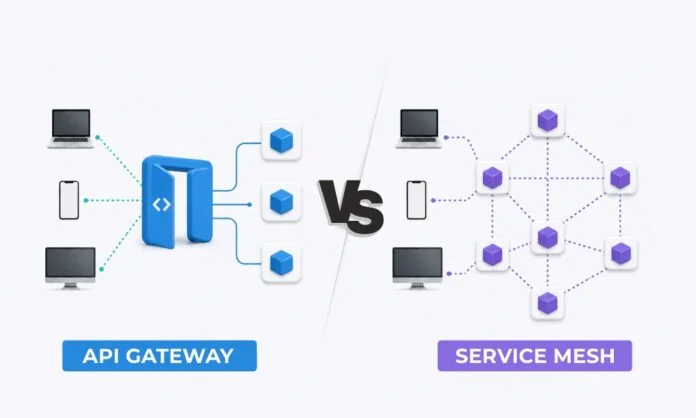
An API Gateway manages external API traffic, whereas a Service Mesh handles communication between internal microservices. Both platforms differ in certain parameters you should know about. This blog dives into the API Gateway vs. Service Mesh comparison, including their key differences, use cases, and when to use each in a microservices stack.
What is Service Mesh?
To put it simply, Service Mesh is a software layer that manages communication between microservices. It aims to streamline service-to-service communication by using a network of lightweight proxies, improving security, reliability, and observability with no change to application code. Service Mesh directs microservices to perform data exchange at the internal layer.
Some of the key aspects of Service Mesh are:
- Traffic management: Intelligently routes requests such as directing traffic to a new version of a service.
- Security: Encrypt communication between services and block unauthorized access.
- Reliability: Improve fault tolerance with built-in tools for timeouts, error handling, and more.
- Observability: Service Mesh offers unparalleled visibility into the interactions between microservices.
What is an API Gateway?
An API Gateway is software that sits in front of a group of application programming interfaces (APIs). It’s the key access point for users interacting with an application. It fields requests from clients like mobile apps and web applications. When a request is received, the API gateway routes it to the appropriate backend microservice, determines where it needs to go, applies security checks, and returns the appropriate response.
The API Gateway functions as a single point of entry for API calls. It enforces security policies and manages API traffic, combining or transforming service responses to deliver a smooth client experience.
Some of the key aspects of API Gateway are:
- API request handling and routing: The API Gateway inspects request details and routes incoming requests to the appropriate backend service.
- Authentication and authorization: Verifies user identity and controls access to APIs.
- API version management: Supports different API versions without disrupting existing users.
- Security: Enforces authentication, authorization, and threat protection at the edge before requests reach internal systems.
API Gateway vs Service Mesh Comparison at a Glance
Here we will compare API Gateway and Service Mesh across key areas, so you can make a well-informed decision about choosing the right microservices strategy for enterprise application development.
Parameter |
API Gateway |
Service Mesh |
| Key function | Manages and secures external communication between clients. | Effectively manages service-to-service communication between microservices. |
| Security setup | Offers automated security features. | Needs a manual setup of security controls. |
| Deployment | Lies at the edge of the application as a single-entry point. | Runs alongside microservices, mainly using sidecar proxies. |
| Traffic type | North-south traffic (client-to-application). | East-west traffic (service-to-service). |
| Security role | Identifies who is allowed and blocks bad requests from outside. | Secures internal traffic using mTLS and access policies. |
| Observability | Offers monitoring tools for API traffic. | Offers insights into the service health and communication patterns. |
| Best use case | Exposing APIs to web, mobile, and third-party clients. | Managing communication within complex microservices architecture. |
API Gateway vs Service Mesh: How to Choose the Right Tool for Your Stack
Below are some of the best use cases of API Gateway and Service Mesh that guide you towards choosing the best stack for your enterprise application.
API Gateway Works Best for:
- Simplifying API management and versioning.
- Centralized API traffic management.
- Managing and securing external API traffic.
- Monitoring API usage and performance.
Service Mesh Works Best for:
- Decentralized and scalable microservice communication.
- Effectively managing communication within a complex microservices architecture.
- Securing internal traffic with mutual TLS (mTLS).
- Reducing application-level network complexity.
- Improving observability with distributed tracing and metrics.
Should You Use Both? API Gateway and Service Mesh
In a modern microservices architecture, it’s often best to use both an API Gateway and a Service Mesh, since they serve different purposes. The API Gateway protects external API traffic, and a Service Mesh handles and secures internal microservice communication. Using both together can give full traffic management and more robust application security.
This also makes it easier to manage applications as your infrastructure expands. The API Gateway provides the only interface for client access, while the Service Mesh enhances service reliability, observability, and fault tolerance. Together, they enable organizations to develop scalable, resilient, and cloud-native applications.
Summing It Up on API Gateway vs Service Mesh Comparison
API Gateways and Service Meshes serve different purposes. However, together they create a stronger and more efficient microservices architecture. Instead of choosing one over the other, organizations should focus on carefully evaluating their architecture, security requirements, and scalability goals. Hope this blog has given a clear overview of both the architecture and help you make a well-informed decision regarding choosing the best microservice stack for your needs.
Read more informative blog posts around the tech landscape here.
FAQs
1] What are the most popular API Gateway and Service Mesh tools?
Answer: Some of the popular API Gateways include NGINX, Apigee, and AWS API Gateway. Alongside, popular Service Mesh solutions include Istio, Kuma, and Linkerd.
2] Can a Service Mesh be integrated with Kubernetes and cloud environments?
Answer: Yes, a Service Mesh is compatible with Kubernetes and other cloud environments. It handles service-to-service communication, traffic management, and security, making scaling easier.
Recommended For You: