
LinkedIn has redefined professional networking for over a billion users worldwide. More than a platform, it is a trusted companion for professionals and businesses, supporting careers, enabling opportunities, and strengthening brands through valuable connections. However, users have noticed significant changes in their LinkedIn Feed lately.
Earlier, more posts meant more views and engagement. Recently, this strategy has not been very effective as creators and businesses have observed a noticeable decline across their views and engagement graphs even after posting more often. The reason? Definitely LinkedIn’s changing Feed algorithm across regions.
The social networking platform has been integrating AI capabilities, especially large language models and Generative Recommender models, to transform how its Feed works. The key objective behind the LinkedIn Feed algorithm update 2026 is to understand and show content that resonates with the users. In other words, LinkedIn is taking initiatives to show exactly what users want to see in their Feed.
So, let us understand how LinkedIn’s Feed algorithm is changing and how businesses and professionals stay ahead.
Understanding LinkedIn Feed Algorithm Update 2026:
LinkedIn’s Feed and content engagement parameters are changing remarkably. The social networking platform is improving its Feed to show more relevant and authentic professional content to users. It has redesigned its Feed to use large language models and new ranking engines.
The goal is to show members’ posts that truly match their professional interests, in near real time. The company says the update moves beyond simple engagement counts and toward deeper content understanding and member context.
Though LinkedIn has depended on AI models for years now, it has limitations. The platform used past engagement of users as signals to predict their present interests. For example, if a user clicked on a crypto post two years ago, similar content continued to show up on their Feed. No matter if the users’ interest shifted from crypto to something else.
LinkedIn understood that user interests evolve continuously, and the strategy of depending on past engagement became obsolete while analyzing the real-time interests of users.
Another aspect that contributed to LinkedIn’s Feed algorithm change is the surge of posts with engagement-bait. Among these, posts asking users to ‘Comment Yes if you agree’, images and videos with irrelevant captions, and repetitive thought leadership insights, are significant. These posts primarily manipulate the organic engagement metrics while offering minimal value.
Key Technologies Used in the New LinkedIn Feed Algorithm-
LinkedIn is primarily using two major technologies to redefine its Feed and show content that resonates with diverse users.
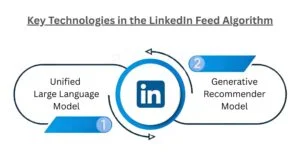
Unified Large Language Model:
LinkedIn is shifting from its old multiple sources-based content retrieval method and adopting a unified LLM-based retrieval system. The platform will use LLM to analyze which posts will be relevant to a user, assessing their work, current role, changing behavioral signals, and present engagement metrics. Additionally, LLMs process world knowledge that helps in connecting keywords in real time and showing semantically relevant content.
Generative Recommender Model:
The generative Recommender model helps in ranking relevant content on a user’s Feed. It analyzes the user’s interaction history with an ordered sequence. In this way, the GR model evaluates engaged posts chronologically while identifying patterns in the changing professional interests of users.
Beyond identifying patterns, the GR model understands the context of each post a user has engaged with. It is a quick process that operates each time users engage with a new post, which is treated as a signal, leading to Feed updates.
What Changes Does the LinkedIn Feed Algorithm Update 2026 Bring?
According to LinkedIn, it is changing the following aspects in its feed algorithm:
Smarter content ranking using Generative Recommenders and LLMs:
LLMs and the Generative Recommender help in finding patterns in users’ professional interests in real time. Each occasion of engagement on LinkedIn imparts a signal. LLMs and GR models analyze these signals alongside your role, location, and world knowledge to integrate smart content rankings on your Feed.
Action against automated comments and inauthentic engagement:
LinkedIn Feed Algorithm Update 2026 aims at promoting authentic engagement and conversations. LinkedIn is a platform where users prefer to get insights from authentic professionals. However, automated and inauthentic content has increasingly replaced authentic voices in recent times.
LinkedIn takes strict action against such activities, ensuring that users see and engage with real persons and authentic posts, interacting from a real perspective.
Less generic content and engagement bait:
LinkedIn is also intending to limit repetitive, low-value videos with irrelevant texts and engagement bait posts. Users will now see genuine posts on their Feed with valuable insights, practical ideas, thoughtful perspectives, and posts with inauthentic engagement bait.
Better personalization for new members from day one:
Previously, LinkedIn Feed relied on complete profiles and engagement to receive signals and rank content. However, LinkedIn is testing an Interest Picker that will show up while signing up, supporting new members in personalizing their Feed. From now on, new LinkedIn members will be able to select topics of their interests, such as Leadership or Career Growth. Their Feed, accordingly, gets personalized.
How Does LinkedIn Feed Work Now?
Professionals, creators, and brands must understand the process of how the revamped LinkedIn Feed algorithm will work to plan effective content strategies, driving authentic engagement. The process follows three major steps.
Quality Filtering:
The new LinkedIn Feed algorithm distributes overall content and posts on the platform in categories of spam, low quality, and high quality. Posts violating LinkedIn’s policy are suspended at the earliest. Low-quality and spammy posts, including repetitive content, automated scripts, and engagement bait, are not prioritized in the Feed while ranking.
Engagement Testing:
In the following stage, the Feed algorithm tests the engagement parameters of the post. It is to analyze how the audience responds to a post in the initial hours. LinkedIn now focuses on meaningful engagement with thoughtful comments and interactions. The algorithm then shows the posts to the first, second, and third-degree connections, analyzing relevance with the users’ interests.
Network and Relevance:
The third stage includes three aspects, including identification, content relevance, and member activity. These are core user signals that help LinkedIn improve and rank relevant posts. The algorithm first identifies the viewers, their profession, skills, geography, and other details.
Secondly, users’ interest and their changing behavior are analyzed to identify relevant posts for users. Lastly, LinkedIn evaluates user interaction with their connections and overall network. Alongside that, the following hashtags and searched topics are also used as signals to rank posts.
Impact on B2B Marketers:
The LinkedIn Feed Algorithm Update 2026 is a shift from volume and tricks to clarity and depth for B2B marketers. Content that explains a problem, shares a real example, or teaches a small skill is more likely to be recommended.
Performance metrics for the B2B audience will lean on meaningful engagement, such as thoughtful comments and saves, over raw like counts. Early reporting suggests the new system rewards topical expertise and long-form native posts more than recycled listicles and generic motivational posts.
How do Professionals Plan Their Content Strategy?
- Lead with value. Write posts that teach, solve, or reveal insight. Short punch lines are fine, but back them with an example or resource.
- Be explicit about a topic. Use clear headings, tags, and the first lines to state what the post is about. The retrieval layer looks for crisp topical signals.
- Avoid engagement bait. Do not prompt hollow comments or use comment farms. Encourage real discussion by asking targeted, specific questions.
- Use native formats. Native text posts, documents, and thoughtful videos that keep users on LinkedIn tend to perform better than immediate external link drops.
- Monitor and iterate. Track saves, comments, and the type of accounts interacting with your posts. If professionals in your niche engage, that is a strong signal the model will amplify.
- Mix formats and repurpose carefully. A detailed long post, a short summary, and a slide document can reach different parts of the audience without repeating the same shallow message.
Wrapping Up!
LinkedIn Feed Algorithm Update 2026 rewards clarity, expertise, and real conversation. If your content helps people do their work a little better, it has a much better chance of being seen now.
The update explicitly weakens signals that historically boosted reach but added little professional value. That includes engagement bait, repetitive “comment to agree” prompts, automated or inauthentic comment factories, and very generic repackaged content.
So, plan your content strategy thoughtfully and strategically to achieve authentic, higher engagement on your LinkedIn posts. Read our in-depth blogs and stay aligned with the changing technological era!
FAQs:
1. How does LinkedIn’s algorithm work in 2026?
Answer: In 2026, LinkedIn’s algorithm prioritizes users’ real-time interest graphs, ranking posts that resonate most with their interests in the Feed.
2. What content works best on LinkedIn?
Answer: Authentic content that imparts genuine value among users is likely to get enhanced engagement on LinkedIn. Additionally, it is important to create posts that are relevant to LinkedIn users.
3. What is the 5-3-2 rule on LinkedIn?
Answer: The 5-3-2 rule on LinkedIn is a content strategy framework that brands and creators use to build engagement with their connections. It includes 10 posts, including five curated content pieces from others, three original content pieces, and two personal content pieces.
Related reads:
LinkedIn Launches Two New Features To Build a Better Networking Channel