Broaden your knowledge and get inspired by our leading technology interview series, ExtraMile by YourTechDiet. We feature candid conversations with change-makers and innovators in the tech industry. Our latest conversation focuses on healthcare data orchestration that plays an important role in bringing information together across systems and creating a connected healthcare environment.
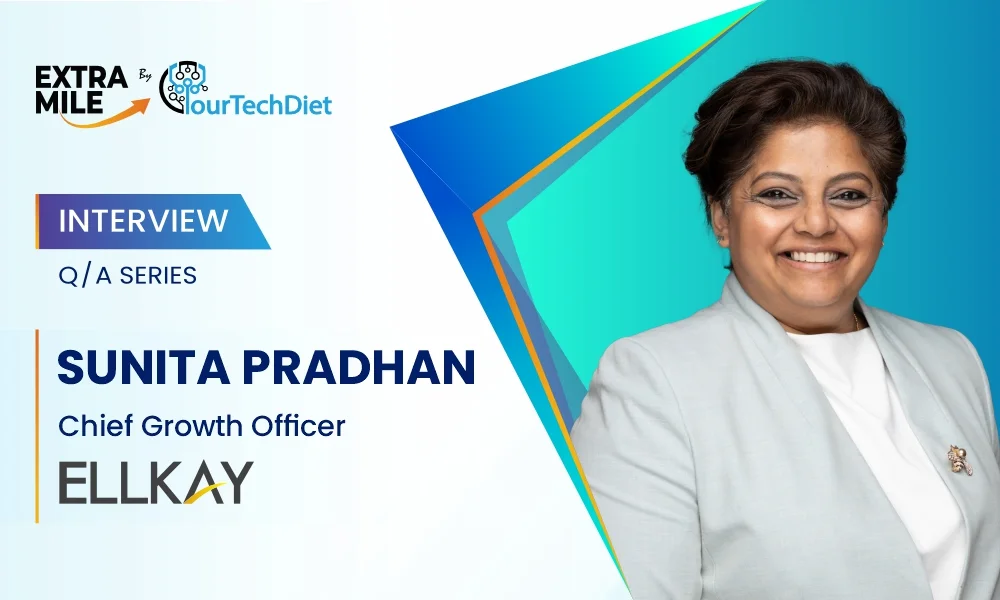
To walk us through this aspect, we’re joined by Sunita Pradhan, Chief Growth Officer at ELLKAY. The firm orchestrates the interfaces, networks, and data behind healthcare’s leading organizations, connecting 750+ EHR/PM systems and 58,000+ practices nationwide.
Our featured guest, Sunita, strongly believes in the importance of people and trust. She champions user readiness alongside technical execution. Here at ELLKAY for the past 15 years, she has helped guide the company’s evolution from specialized lab connectivity to a comprehensive platform for managing and exchanging clinical data.
In this conversation, Sunita shares insights into her interest in healthcare technology, ELLKAY’s customer-centric approach, the importance of interoperability, and why data readiness is the key to successful AI adoption. She also highlights the role of healthcare data orchestration in creating a connected data environment and the major transformations in healthcare interoperability and data infrastructure.
These insights are indeed a must-read for healthcare leaders and professionals looking to embrace digital transformation and innovation on a global scale! Let’s dive in..
1. What initially drew your interest in healthcare technology, and what has kept you passionate about the industry throughout your career?
Sunita. It’s a bit of a family story. Both my parents were in IT, so technology was just the air I grew up in. I started college pre-med, planning to be a pediatrician, and instead spent ten years in my mother’s consulting and Edtech firm. The funny thing is, a fortune teller once told me I’d work in healthcare but never be a doctor, my work would be in educating others, but I’d never be a teacher. I laughed it off. I’m not laughing now.
What made it stick was my first healthcare IT job, at a small company working on remote stroke diagnosis. I watched technology put a neurologist in front of a patient in time to matter, and that was it for me. What keeps me here is that healthcare problems don’t clock out at five. They’re what someone is still thinking about at dinner, or lying awake with at night. Getting to help solve even one challenge never gets old.
2. Having worked across hospitals and health systems, what are some of the technology challenges you see healthcare organizations face even today?
Sunita. Picture a clinician about to make a call on a patient. Somewhere there’s a lab result, a record from the clinic across town, a chart in a system that was retired years ago. Whether any of it reaches that clinician in time depends on a lot of vendors, and each one is only responsible for its own part. A typical healthcare organization has 40+ of them. Most arrived for good reasons: each new regulatory requirement, from meaningful use to TEFCA, brought a new wave of vendors built to meet it. When something falls through , everyone can truthfully say it wasn’t theirs.
That’s the challenge I see most, and it’s easy to live with because it never shows up as a line item. It shows up as a clinician working without the full picture, a migration that runs long, an AI project that stalls because the data wasn’t ready. Usually a patchwork of teams has been quietly holding it together for years.
It matters more now because AI, consolidation, and national networks all assume data already moves cleanly between systems. It doesn’t. That’s why we talk about healthcare data orchestration. All it means is that someone is accountable for how the pieces work together, so the clinician gets the whole record and the patient isn’t the one who pays for the handoff.
3. ELLKAY has built a strong reputation for being the partner healthcare organizations can rely on when systems break, or data needs to move. How has this standout customer centric approach shaped the company’s growth over the past 20+ years?
Sunita. We grew by showing up when something was broken. In the early days, that meant getting demographic and insurance data onto lab requisitions. We built the fix, and then we stayed to run it. That’s the difference between a vendor and a partner: a vendor hands off when their piece ships, and a partner is still there after go-live.
Then our customers’ needs changed, and we changed with them. Practices that could now create a lab requisition right from their practice management system moved to electronic medical records, and they needed their data to come along. There was no solution for that, so we stepped up and built one. As the practices we served grew into larger groups and then hospitals, the same problem grew with them.
Migration raised a second question. A new EMR shouldn’t inherit every old record, because bad data slows it down and defeats the reason for having one. So the patient-critical data moves over so care can continue, and everything else goes into an archive, because providers still have to retain it for years. That’s how archiving became part of what we do: continuity of care on one side, retention on the other, and nobody swiveling between systems or living with the security risk of keeping the old ones around.
Hospitals brought the same lab connectivity and data conversion needs, plus much heavier interface demands, since by then every new requirement had added another vendor that didn’t talk to the others.
Twenty years of that has added up to 64,000+ interface connections managed and 750+ PM and EHR systems connected for demographics data across 1,100 versions, the same data we started with. The proof I care about most is quieter, though. For example, when a 10-alarm fire hit Signature Healthcare, continuity of care was maintained for 176 patients.
It also shaped what we built. Someone calls about archiving, then asks about labs or payers, so the platform grew around what customers kept asking us to cover.
That’s also why the timing makes sense now. For 20+ years we’ve worked through each of these problems alongside customers, mostly one at a time. Now we can bring that knowledge together across interfaces, networks, and data as one platform, with 4,000 reusable interface templates/workflows behind it.
4. Healthcare organizations operate with complex and disconnected systems. What role does Healthcare Data Orchestration play in helping them create a connected data environment?
Sunita. Simply put, healthcare spent years getting data into computers, and then more years getting those computers to talk to each other. Both were real accomplishments. But if you’re a clinician sitting with a patient, you don’t care that the systems are technically connected. You care whether the lab result, the note from the specialist across town, and the history from the old system are in front of you when you need them. That still isn’t a given.
I got into this work watching technology put a stroke neurologist in front of a patient in time to matter. It taught me that the whole point is getting the right information to the right person at the right moment. Healthcare data orchestration is how we make that happen when dozens of systems are involved. Someone has to look after how it all fits together, not just whether each piece works on its own.
It matters now because the data is finally rich enough to do something with, and everyone wants to: AI, quality programs, value-based care. All of it falls apart if the data isn’t right when it arrives. West Feliciana Parish Hospital went from 20 redundant connections to one. That sounds like a technical detail, but it means fewer places for a patient’s information to get lost.
5. ELLKAY User Group brings together healthcare leaders to share experiences, challenges, and solutions. What are some of the important lessons that have emerged from this year’s conversations?
Sunita. The organizations moving fastest on AI aren’t the ones with the most AI tools. They’re the ones that trust their data. Three things kept coming up.
First, trust. Before anyone talks about models, people are asking where the data came from, who can access it, and whether it’s complete. Second, acquisitions. Every deal brings another EHR and more nonstandard connections, and the team that inherits them is accountable for all of it. Third, the cost nobody can put a number on: a clinician making a decision without the full longitudinal record.
One more lesson was about people. Data, integration, and security teams often sit in different divisions. The organizations making the most progress pull small groups from each of them together around a shared problem.
6. AI is becoming center stage for healthcare organizations, but you focus on starting with the data foundation. Why is data readiness so important before organizations can successfully implement AI?
Sunita. Because AI doesn’t fix messy data. It makes the mess faster and more visible, usually to the board. Gartner predicts organizations will abandon 60% of AI projects through 2026 because the data underneath wasn’t ready.
Healthcare AI rarely fails at the algorithm. It fails at the data layer: the same patient showing up three times, a code that means one thing in one system and something else in another, a result that arrives after the decision was made. Duplicate patients are the least glamorous example and one of the most important. Our patient identity resolution has resolved 1.2B patient records into 470M unique persons, and within CommonWell it achieves accurate linking across all relevant records for 99.99% of patients. A model that can’t tell who the patient is can’t help the patient. Get that right first, and everything you build on top improves. Our solutions focus on maintaining discrete and text data, which inherently adds to AI readiness.
7. In the coming years, what do you believe will be the major transformations in healthcare interoperability and data infrastructure, and how is ELLKAY preparing for it?
Sunita. We’ll stop asking whether systems can connect and start asking whether the data is ready to act on. Three things will drive that.
Networks: nationwide exchange through TEFCA is making it normal to pull a full record from anywhere. ELLKAY supports the technology behind CommonWell, a Designated QHIN,connecting more than 261 million individuals across 125,000+ provider sites, so we’ve seen what scale demands.
Consolidation: more mergers, more EHRs to fold in, and more pressure to retire legacy systems without losing a single record. We support data archiving from 486 systems today.
AI aimed at the integration work itself: the joke at our User Group is that your innovation program can only move as fast as your integration backlog. We’re putting AI to work on that backlog so interface teams spend less time on configuration and more on what the data is for.
Through all of it, our job stays the same: one accountable partner, so nobody’s left holding it together alone.
Check Out Our Other Informative Interviews: