
The B2B industry is becoming increasingly competitive, making it more challenging than ever for organizations to differentiate themselves in a situation of fierce competition. Building trust and authority is crucial while standing out in a crowded market.
Nevertheless, building trust among the B2B audiences is a lengthy process that seeks expertise, transparency, reliability, and security. In this regard, third-party validation plays a significant role while establishing trust and thought leadership across the target market. Third-party validation offers reliable social proof that leads to higher engagement and conversions.
Data reflects that over 50% of B2B decision makers depend on social proof while making a buying decision. While third-party validation drives impactful social proof in the B2B environment, buyers find firms with social proof more credible to address their pain points.
In this blog, we will discuss how third-party validation helps B2B tech brands grow in the competitive industry. But firstly, let us understand what third-party validation is.
What is Third-Party Validation?
Third-party validation is a methodology according to which a third-party, or a totally different firm, publicly acknowledges and recognizes your brand and your offerings. It further legitimates the performance and credibility of a firm. Third-party validation is also known as external endorsement, earned credibility, and objective recognition.
For B2B tech brands, third-party validation plays the role of a catalyst that helps in establishing trust among possible prospects and boosts the credibility of a firm. Gaining external endorsements in B2B depends on specific methods, including reviews on review platforms, industry awards, media coverage, PR, collaborations, testimonials, and quality certifications.
The Significance of Third-Party Validation in B2B Tech Brands:
The B2B industry runs on trust and long-lasting collaborations. And trust is sustained by credibility. Similar to B2C, B2B buyers also rely on reviews and external recognition nowadays. Third-party validation plays a significant role for this purpose, allowing B2B buyers to learn how credible a product is and how often audiences choose it.
Here are the benefits of third-party validation in B2B tech setup-
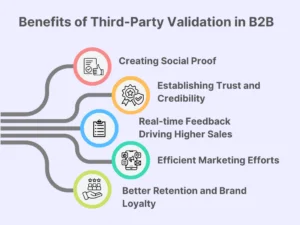
Creating Social Proof: Third-party endorsements work as social proof for B2B tech brands. These not only validate the existence of a firm but also recognize its services. Additionally, it also justifies how a particular service is relevant to address diverse customer needs.
Establishing Trust and Credibility: Since the B2B industry is becoming highly competitive, building trust and credibility among possible prospects is crucial. In this regard, third-party validation authenticates a firm’s claims about its services that ultimately help boost trust and credibility.
Real-time Feedback Driving Higher Sales: External validation provides B2B buyers with real-time feedback on a brand and its services. This helps in boosting sales and achieving sustainable growth.
Efficient Marketing Efforts: Marketing teams gain an extra edge. Marketing endeavors require social evidence to validate the claims of a firm. Third-party endorsements fill the gap between brands and their marketing excellence by providing authentic social proof.
Better Retention and Brand Loyalty: Long-term relationships are a core element of the B2B industry. Since third-party endorsements establish trust and credibility, it also contributes to brand loyalty that ultimately drives higher customer retention.
Examples of Third-Party Validation:
Third-party validation can be attained through several methods. Here are the common ways-
1] Peer Reviews on Review Platforms: Positive reviews on review platforms like G2, Capterra, and TrustRadius are an advanced strategy to gain third-party validation.
2] Industry Certifications: Industry certifications for quality and consistent performance, like ISO, GDPR, and HACCP, contribute to third-party validation for B2B tech brands.
3] Industry Accreditations: Awards from leaders for outperforming a specific domain also play the role of third-party validation.
4] Media Features and PR: Media coverage and press releases by reputed publications offer strong third-party endorsement. It also helps in impactful lead generation.
5] Industry Partnerships: Collaborations with other firms to make advancements in specific areas also drive third-party credibility for B2B brands.
6] Testimonials: Client-driven case studies and testimonials assist brands in attaining third-party recognition, contributing to enhanced trust.
Challenges of Attaining Third-Party Validation:
- Higher Cost: Achieving third-party endorsement requires significant investment. Additionally, if there is a lack of quality and consistency in services, the return on investment (ROI) can be impacted.
- Process Complexity: The process of getting third-party validation is a lengthy and complex one. Managing audits, technical components, and risk management initiatives can create challenges for B2B brands and the endorsement-providing firm.
- Sudden Changes: Brands undergo several transformations, such as service changes, acquisitions, and more. Under such circumstances, maintaining consistency is a challenge. This may also create a hurdle in gaining third-party endorsement.
- Finding the Right Partner: B2B brands often struggle to choose the right partner to promote their business. In this regard, assessing and aligning goals is crucial. If the goals differ, the outcomes can also be misaligned. Additionally, if the source is not credible, a brand can also fail to gain quality attention.
Getting Started with Third-Party Validation!
Third-party endorsement assists B2B tech brands to validate, authenticate, and promote their services among the most appropriate audience. It further establishes trust and brand loyalty. Trust is a core element of B2B operations and success. It contributes to better collaborations, risk-free transactions, and long-term partnerships.
Hence, attaining third-party validation not only establishes trust but also allows for building long-term relationships that can drive lasting business growth.
YourTechDiet is a leading publication for tech-driven content and news. We collaborate with tech brands and support them to grow with remarkable web traffic and thought leadership. Contact us today, and validate your services across the global readership, including industry leaders, C-suite professionals, and decision-makers.
Recommended For You: