
Generative AI (GenAI) is an artificial intelligence system that can create new content, including text, images, audio, and video, by analyzing patterns in existing data. Generative AI in claims management is just one part of the broader incorporation of generative AI in the insurance industry.
Let us understand the role of generative AI in insurance processes, including how it enhances the efficiency of claims management.
Generative AI for Managing Claims in Insurance
Generative AI in claims management streamlines processes, making them quicker, more unbiased, and more transparent. In 2025, the global value of generative AI in the insurance market was $1.09 billion. It is expected to reach $17.27 billion by 2035 at a CAGR of 31.82%.
These are the areas where GenAI helps manage claims in insurance:
- Automation of FNOL (First Notice of Loss) Intake: AI virtual assistants can collect primary claim information from policyholders through Natural Language Processing (NLP) conversations, immediately populating claim files, and launching downstream operations.
- Smart Document Processing and Authentication: GenAI can assess and validate submitted claim documents, such as damage photos, police reports, and invoices. It can flag inconsistencies or indicators that raise suspicion for human agents to check.
- Automation of Claims Triage and Allocation: GenAI can automatically route claims to the appropriate human adjuster or dedicated unit based on the claim’s nature and complexity. This ensures efficient resource distribution.
Benefits and Challenges of Using Generative AI in Claims Management
Generative AI in claims management, underwriting, and customer service can automate repetitive tasks, decrease delays, and improve decision-making. Apart from that, GenAI also helps in risk management in the insurance and claims management ecosystem. AI algorithms, in this regard, help accelerate, automate, and enhance the entire risk evaluation process, which is also known as GenAI underwriting.
Here are the benefits and challenges of implementing GenAI for the insurance industry.
Benefits
- Improved fraud detection: Human insurance agents may find it challenging to scan every claim for suspicious behavior. GenAI can ease this process by checking patterns in claim history, customer conduct, and email tone. AI insurance automation can also help teams write reports while documenting questionable claims.
- Faster decision-making: GenAI can automate document verification, summarization, data extraction, etc. This eliminates the need for human intervention and reduces errors, thereby speeding up insurance claims processing.
- 24/7 access for customers: Customers may not understand their policies, have queries in another language, or need answers outside working hours. GenAI can manage all these tasks and be available around the clock.
- More efficient administration: AI insurance automation can streamline tasks such as form filling, data copying, and writing follow-up emails, reducing the administrative burden on personnel in insurance claims processing.
Challenges
- Lack of data privacy: GenAI creates new content by assessing existing information on the internet. Customers may not want to share sensitive personal or corporate data on these AI platforms in case of security breaches.
- Governance ambiguity: Generative AI regulations are always changing. Without clear, comprehensive protocols for pricing strategies and customer data, customers may hesitate to use GenAI platforms. Life and health insurance are more prone to ambiguity than other types of insurance.
- Unclear ROI models: It is hard to determine a tangible ROI for GenAI insurance models, especially metrics that can’t be quantified, which makes it difficult for insurance businesses to adopt these models.
- Complex Integration with existing IT systems: Merging generative AI with fragmented, existing technological infrastructure can be complicated and costly.
Implementing GenAI in Your Insurance Business
Integrating generative AI in claims management, underwriting, risk assessment, and more doesn’t have to be complicated. Follow these six simple steps:
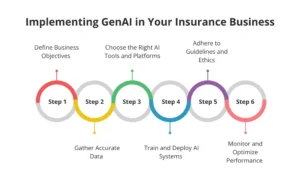
Step 1: Define Business Objectives
The first step in implementing any new technology is understanding its objectives and goals within the business. In insurance, a claims manager may want to reduce backlogs, while an underwriter may want quicker risk evaluation from the AI.
It is better to start with a single measurable outcome, such as a shorter claims cycle or quicker underwriting. Then base the GenAI implementation strategy on this to be cost-effective rather than running an expensive experiment.
Step 2: Gather Accurate Data
It is important that the data GenAI learns is accurate for an efficient insurance tool. Outdated legacy systems, inconsistent formats, and unorganized documentation can result in incorrect data delivery.
Systemizing and consolidating all information may be time-consuming, but it eventually improves all downstream processes.
Step 3: Choose the Right AI Tools and Platforms
There are many AI tools and platforms with excellent features. Some platforms may be better at image analysis or workflow automation, while others excel at natural language generation. Find the tools and platforms that suit your business’s requirements. The best option is the model that integrates seamlessly and supports insurance operations in the long run without being too complex.
Step 4: Train and Deploy AI Systems
The GenAI model may run perfectly during testing but face issues when exposed to actual customers or scattered case files. It takes time and training, through observation and refinement of data and results, to perfect the AI model.
Step 5: Adhere to Guidelines and Ethics
GenAI decisions include pricing, claims review, eligibility, and communication. Errors in these results may lead to regulatory violations and damage customer trust. This is why it is important to set strict guidelines for defining data usage, transparency, and decision reviews.
Step 6: Monitor and Optimize Performance
AI models are continuously learning new market trends and customer patterns. They need to be consistently updated with new data so that they can recognize the latest fraud attempts and other emerging risks.
It should be regularly monitored, audited monthly, and retrained as needed. This helps maintain accuracy, build stronger resilience, and be reliable in the long-term.
Future of Insurance with GenAI
Generative AI will restructure insurance processes, making them more innovative and efficient. These are the key future trends of this technology:
Personalized Insurance
GenAI will allow insurance policies, premiums, coverage, and benefits to be hyper-customized according to the needs and risk profiles of specific customers. This will be made possible by using a variety of data sources, including IoT devices, social media, and wearables.
Proactive Security and Risk Management
Generative AI in insurance will enable predictive analytics that will include early recognition of potential risks. This will help insurers execute preventative measures to reduce losses. Targeted outreach to high-risk groups, tailored health and safety recommendations, and customized risk mitigation plans can also be implemented with this technology.
Improved Customer Experience
Generative AI in claims management systems will enable virtual assistants and chatbots that offer personalized support around the clock. They will address inquiries, process claims, and resolve issues. This technology will also improve communication by drafting tailored information that is engaging and relevant to customer needs.
Better Insurance Compliance
GenAI will enhance compliance by automating policy document generation, contract assessment, and regulatory reporting. GenAI will identify potential compliance concerns, streamline reporting processes, and ensure regulations are followed to boost efficiency and reduce costly penalties.
Key Takeaway
Generative AI in claims management, customer service, risk assessment, underwriting, and more is driving innovation at every stage in the insurance industry. From tailored insurance policies to automated claims processing, GenAI is enabling enhanced efficiency, better customer satisfaction, and improved risk management. Insurance businesses that invest in this new technology will gain a competitive edge over others in the industry.
Visit YourTechDiet for more blogs related to advancements in AI.
FAQs
1. How does generative AI detect suspicious activities in insurance claims?
Answer: GenAI detects suspicious behavior by assessing large volumes of structured and unstructured data. It learns what “normal” information looks like and flags deviations.
2. What are some examples of insurers that have streamlined claims processing?
Answer: Companies like Helvetia, MetLife, and Allianz have streamlined claims processing, automated image analysis, and automated triage to speed up decision-making.
3. What is the main difference between traditional AI and generative AI approaches to insurance operations?
Answer: Traditional AI follows rules and is predictive. It is used for tasks such as fraud detection and automated underwriting. On the other hand, generative AI creates new content in the form of text, images, videos, etc. It is used for simulating risk scenarios for training and underwriting, producing responses in multiple languages in real time, and similar tasks.
Recommended For You:
Are Generative AI Models Becoming Commodities or a Core Business Differentiator?