
Anthropic has released Claude Fable 5.2 and Claude Mythos 5.2 to target complex technical challenges across diverse sectors and industries. The models were announced on November 9, 2026, bringing improvements in coding, reasoning, cybersecurity, and vision.
The new models focus on handling demanding engineering projects, advanced research, and extended agentic workflows. Anthropic reports that the models generate outputs up to 30% faster than their predecessors. They also come with lower API pricing than the previous versions.
Both models have the same underlying architecture but have different safety restrictions. Claude Fable 5.2 includes cybersecurity and biology safeguards, making it available to a broader audience. On the other hand, Mythos 5.2 provides access to these capabilities for verified organizations working on approved cybersecurity and biomedical research applications.
Notable to mention that Anthropic launched the predecessors of the latest models, Claude Fable 5, Claude Mythos 5, Claude Fable 5.1, and Claude Mythos 5.1 in 2026. Hence, the recent releases reflect the company’s step to lead the AI race with significant improvements while handling highly complex tasks.
Improvements Across Coding, Cybersecurity, Reasoning
Coding remains one of the major areas of improvement in the latest models. According to Anthropic, Fable 5.2 can handle complex software engineering tasks with limited human intervention. It has helped engineers fix difficult bugs, optimize services, and complete extensive software migrations.
Similarly, cybersecurity capabilities have also improved significantly in the new models. Anthropic identifies Mythos 5.2 as its most capable model for cybersecurity engineering. It can identify vulnerabilities, reproduce security issues, and assist with remediation.
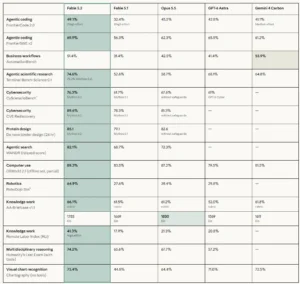
On Anthropic’s internal CVE Rediscovery evaluation, Mythos 5.2 found 10.2% more vulnerabilities than Claude Opus 5.5. It also identified 14.4% more vulnerabilities than Mythos 5.1.
These enhancements extend to reasoning and research tasks as early testers report better performance on ambiguous problems requiring planning, analysis, and engineering judgment. The models can also coordinate complex, multi-stage workflows more effectively. Here is a detailed assessment of how Claude Fable 5.2 and Mythos 5.2 perform across key benchmarks assessing leading capabilities-
Source: Anthropic
Addresses Challenges Across Theoretical Physics, Biological Research, Mathematics, Hardware and Robotics
Anthropic has highlighted advancements in scientific research and engineering capabilities, in addition to software development, across its latest models. During pre-release testing, the models helped solve two open problems involving black hole physics reflecting the models’ potential for complex theoretical calculations.
Biological research is another area attaining attention in Claude Fable 5.2 and Mythos 5.2. Anthropic depicted Fable 5.2’s ability to model large protein structures, particularly viral capsids, containing multiple protein components and present considerable computational challenges.
Mathematics is a notable sector where Claude Fable 5.2 has shown remarkable results. To understand it, a team of 1,000 Fable 5.2 agents formalized the proof of Fermat’s Last Theorem in 30 hours with minimal human intervention. The process translated the proof into Lean, a programming language used for mathematical verification.
Hardware engineering and robotics featured prominently in Anthropic’s evaluations as well. Fable 5.2 designed three electronic devices from scratch, including a home voice-assistant hub, a USB speakerphone, and a handheld virtual pet. Each device included a circuit board, a 3D-printed enclosure, and software. All three devices worked without electrical modification.
Anthropic Prioritizes Safety and Security in the Latest Models
The advanced capabilities of the new models have also put safety considerations into focus. Anthropic executed several pre-release evaluations before making the models available for broader user bases. These assessments covered alignment, potentially unsafe behavior, and safeguards against misuse.
The company also introduced new benchmarks to examine concerning behaviors, including attempts to escape controlled environments. The testing also observed the participation of external organizations, including the UK AI Security Institute, Frontier Design, and METR.
Anthropic assessed the risk of high-stakes misalignment as low. It also reported improvements across several alignment measures compared with recent models. In this regard, the distinction between Fable and Mythos remains important. While Fable 5.2 applies cybersecurity and biological safeguards to restrict potentially harmful requests, Mythos 5.2 is intended for verified organizations with legitimate research and security requirements.
Additionally, Anthropic has also strengthened protections against distillation attacks, aiming to prevent unauthorized extraction of model capabilities.
Availability of Claude Fable 5.2 and Mythos 5.2
Claude Fable 5.2 is now available across major cloud platforms, including Amazon Web Services, Google Cloud, and Microsoft Azure. Developers can also access it through the Claude Platform using the model identifier claude-fable-5-2.
On the other hand, Mythos 5.2 has a more restricted rollout. Cybersecurity professionals can apply through Anthropic’s Cyber Verification Program to access the model. Life sciences researchers can request access through its Life Sciences Verification Program.
Pricing has decreased compared with previous versions. Standard API usage now costs $8 per million input tokens and $40 per million output tokens. Anthropic has also introduced an optional Fast Mode for both models, available at $16 per million input tokens and $80 per million output tokens.
Keep track of emerging AI trends, breakthroughs, and models, only with YourTechDiet.
Read More :
Social Intelligence vs. Social Listening: Understanding the Difference for Businesses