
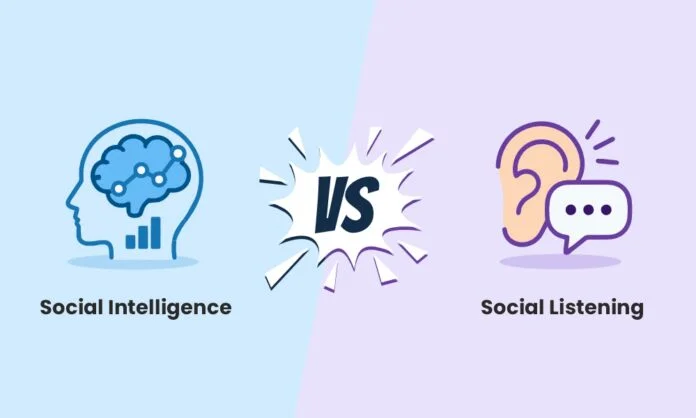
Consumers are busy sharing opinions and experiences on social media regarding the brands they use. These experiences may be positive or negative; however, companies still don’t adopt basic monitoring, which makes social listening and social intelligence confusing. These concepts are not the same.
Social listening is monitoring social conversations to hear what people are saying, and social intelligence is gathering audience information and turning social data into business intelligence to make sound decisions, not reports. To help you understand the differences between social intelligence and social listening, we’ve curated this blog. Dive in now and explore its benefits, examples, and use cases.
What is Social Intelligence?
Social intelligence shows you where your brand stands in the market. It turns conversations, engagement, and audience behavior into insights that help marketers make better business decisions. The key benefit is that social intelligence helps you understand what your competitors are doing, what current content trends are, and how your performance compares with competitors.
Social intelligence answers questions listening cannot. The main difference is that its capability goes beyond social data. It answers the following questions:
- Are you gaining or losing engagement against the competitors you compete with?
- What shift is driving the adoption of competitors’ products?
- Are competitors posting in different content formats than before?
These insights go beyond social data. It combines social data with search behavior, news coverage, consumer surveys, and more to provide a better understanding of market trends, audience behavior, and more.
What Does Social Intelligence Deliver?
- It understands audience behavior, themes, and more to help brands measure their performance against competitors, identify industry shifts, and customer preferences.
- Track competitor campaigns, share of voice, and content strategy to help your brand perform better and stand out from the rest.
- Monitoring conversations in real time can help resolve issues before they escalate.
According to industry reports, “The global social intelligence market was estimated at $3.29 billion in 2024 and is expected to grow from $3.99 billion in 2025 to 23.46 billion by 2035, with a CAGR of 19.55% during the forecast period. “
What is Social Listening?
Social listening is about monitoring conversations about brands, products, keywords, or any topic on social media. It’s an approach to monitoring what customers are actually saying about the business on social media. It gives a clear, real-time understanding of what people think about your business.
The output here is mainly quantitative, with mention volumes, share of voice, sentiment scores, and engagement metrics that are delivered through automated reports and dashboards. The key idea behind social listening is keyword tracking: you define the hashtags and brand names you want to monitor, and the platform surfaces matching content from Facebook, Instagram, YouTube, and other sources.
What Does Social Listening Deliver?
- Gives insights into where conversations are happening and on which platforms.
- The content topics that generate the most engagement.
- How many times your brand has been mentioned in the past 24 hours.
- Get to know if the overall sentiment is trending positively or negatively.
According to industry data, “The global social listening market was valued at $9.2 billion in 2024 and is expected to scale from $11.7 billion in 2026 to $20.2 billion by 2030, considering the surge in the growing use of social media platforms.”
The Key Differences You Need to Know: Social Intelligence vs Social Listening
Below, we have shared a clear comparison of the two approaches. Review each parameter carefully and choose the right option to make the right decision.
| Parameter | Social Intelligence | Social Listening |
| Key question | Why is it important? | What are people saying? |
| Purpose | Unlock strategic insights, benchmark and drive business growth. | Understand sentiment and respond to issues quickly. |
| Output format | Briefings and recommendations | Reports, dashboards, graphs, etc |
| Data source | Social + news+ search | Social media channels |
| Speed | Close to real time | Weeks and months |
| Looks at | Competitors | Your own channels |
| Application | Product development, brand strategy | Customer service, campaign monitoring |
Other differences include:
Social intelligence uses different types of conversational data, not just social media data.
- It is objective-driven, and it is targeted to meet a goal.
- Insights can be unlocked through manual research.
- It helps to identify market trends, competitor strategies, customer preferences, and more.
On the other side:
- Social listening uses only social media data.
- It can include information that doesn’t answer a particular question.
- It helps to monitor what people are saying about a brand on social media.
When to Use Which? Social Listening vs Social Intelligence
The right choice depends on the decision you want to make. Here are some common scenarios:
Use Social Intelligence When:
- You are preparing an annual brand strategy and want to understand how audience values are shifting.
- You need to enter a new market or segment and understand what’s driving the behavior.
- You are working on a campaign and need to understand what matters most to the audience.
Use Social Listening When:
- You need to track the performance of specific hashtags or campaigns.
- You need to analyze emerging industry trends, viral topics, and changes in customer behavior before they peak.
- You need to identify and respond to customer service issues or complaints.
Real World Examples of Social Intelligence and Social Listening
Social Listening: Fitbit built “Reminders to Move.” It tracks social conversations and forums for frequently asked questions regarding the products. The company recognized that many users wanted reminders to move during long periods of sitting. After identifying the recurring request, Fitbit introduced its Reminders to Move feature to encourage users to stay active throughout the day.
Social Intelligence: Coca-Cola, the world’s largest beverage company, analyzes customer reviews, market trends, and competitor activity to understand changing user behavior and preferences and develop products that meet consumer demands.
Summing It Up!
Social listening is a powerful tool that helps brands understand their customers better. On top of that, social intelligence helps them become more successful. In this blog, we’ve explored the key differences between the two. Whether you are monitoring social conversations or turning social data into business intelligence, competitive research, and strategic decisions, make sure you use the right terminology. The way we capture, understand, and act on the consumer’s voice is changing completely. So, it’s time for your brand to gain a competitive edge.
Visit our website to stay updated on trending blog posts across the technology landscape.
FAQs
1. Can ChatGPT do social listening?
Answer: ChatGPT cannot do social listening on its own, as it cannot crawl, collect, or store real-time data feeds from platforms like X, LinkedIn, and Reddit.
2. What are the key elements of social intelligence?
Answer: Social intelligence has four key elements. They are social roles, communication skills and guidelines, understanding others’ motivations, and impression management.
3. Does a brand require both social listening and social intelligence?
Answer: Yes. Listening without intelligence is not knowing whether a result is ideal. Intelligence without listening is missing an early warning, building your own comment section while all the attention points are outside.
You May Also Like:
What is AI in Social Media and Ways to Use it
5 Best Strategies for being Successful with Social Collaboration