
As organizations adopt AI across their workflows, using it the right way is essential. When it comes to the workforce, giving employees access to AI doesn’t make them fully ready. Organizations give employees full access to AI platforms such as ChatGPT, Gemini, Copilot, and other generative AI tools. As per reports, 58% of employees globally regularly use AI tools at work. This denotes the growing buzz of AI transforming the workforce.
What matters is whether employees can use it effectively in their actual work. An AI-ready workforce is one where employees know when, how, and where to use AI in their everyday tasks. Building it requires a combination of skills, learning, and strategy. If you know how to work with it, it can work wonders for your company. So, let’s get started.
What is an AI-Ready Workforce?
AI has immense potential to transform an organization’s workforce. However, the gap lies between AI adoption and workforce readiness. AI readiness goes beyond technical training. This means the workforce has the knowledge, skills, critical thinking, and confidence to incorporate AI effectively and responsibly into their workflows.
These employees know how AI can help to enhance decision-making, automate routine tasks, and unlock long-term value from their AI efforts. In simple terms, “An AI-ready workforce is not where every engineer is an AI engineer. It is an approach where employees know enough about using AI confidently and responsibly.”
What are the Strategic Benefits of an AI-Ready Workforce?
- Improved efficiency and productivity: Employees use AI tools to automate routine tasks, create content, and free up time for high-value work.
- Enhanced innovation: Helps teams discover new ideas, solutions, and business opportunities.
- Decreased operational costs: Improved workflow and reduced manual effort.
What Skills are Required for Building an AI-Ready Workforce?
Organizations should focus on developing the skills below to build an AI-ready workforce.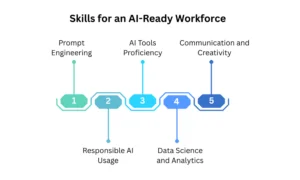
- Prompt engineering: AI delivers great content but struggles with context. Clear, concise prompts help AI deliver better, more accurate results.
- Responsible AI usage: Privacy, security, and ethical considerations are important workplace concerns. Employees should understand responsible AI use.
- AI tools proficiency: Anyone can use AI tools; however, it takes time to understand how they work. Familiarity with AI tools can make employees a key asset in integrating AI into organizational operations.
- Data science and analytics: Employees should have the skills to evaluate data sources, AI models, and output accuracy to ensure reliable, transparent, data-driven decisions.
- Communication and creativity: Creative human skills remain at the forefront in an AI-driven workplace. Communication, creativity, collaboration, and leadership help employees use AI outputs effectively.
Essential Elements for Training Employees for AI Adoption
Keep a few points in mind when building an AI-ready workforce. Review the points below.
- Prepare a Baseline: Get an overview of existing AI knowledge, skills, experience, and confidence.
- Make learning role-specific: A finance team does not need the same AI training as a marketing team. Effective programs connect AI capabilities into the real business workflows.
- Marketing teams: AI-driven content creation, campaign optimization, and customer insights.
HR teams: AI-assisted recruitment workflows, onboarding, resume screening, and responsible handling of candidate data.
IT teams: AI-assisted coding, testing, automation, and AI security. - Provide opportunities to apply and assess skills: Make use of practical approaches and assessments to go beyond awareness.
- Track learning progress: Track learning activity and assess performance and skills using the right business systems and feedback to evaluate how well employees use LLMs.
Proven Strategies to Prepare Your Workforce for AI
Here are key strategies to prepare your workforce for AI.
- Conduct AI literacy programs: Encourage every employee to learn the essentials of AI. Use courses, seminars, and real-world projects to apply skills in practice and build confidence across your workflow.
- Foster continuous learning: Encourage teams to keep learning about AI. Empower them to stay ahead of the latest trends and practices, and to evolve with the rapidly growing AI landscape.
- Integrate AI into existing tools and workflows: Integrate AI capabilities into existing tools, platforms, and processes. This lowers the barrier to entry for employees, fosters hands-on learning, and delivers immediate value through interaction with AI.
Concluding Lines!
Building an AI-ready workforce is essential today. This approach is not just about implementing new technologies. It involves fostering AI literacy, enhancing critical thinking, and establishing a responsible adoption strategy.
Organizations that invest in learning and employee development can help teams adapt to changing workflows and unlock new opportunities for innovation. Alongside this, strong governance and human oversight ensure that AI is used responsibly. Employees should be well aware of how to use AI effectively in their workforce transformation.
For all the trending blog topics around the tech world, visit our website today.
FAQs
1] What challenges do companies face in AI workforce transformation?
Answer: Companies face challenges like skills gap, privacy concerns, and more.
2] What training and development strategies support an AI-ready workforce?
Answer: To build an AI-ready workforce, focus on skills training, workshops, and cross-functional projects that improve collaboration and knowledge sharing.
You May Also Like:
What Role Can AI Play in the Brainstorming Process?
Human-Centered AI: The Power of People-First Technology for a Better Tomorrow