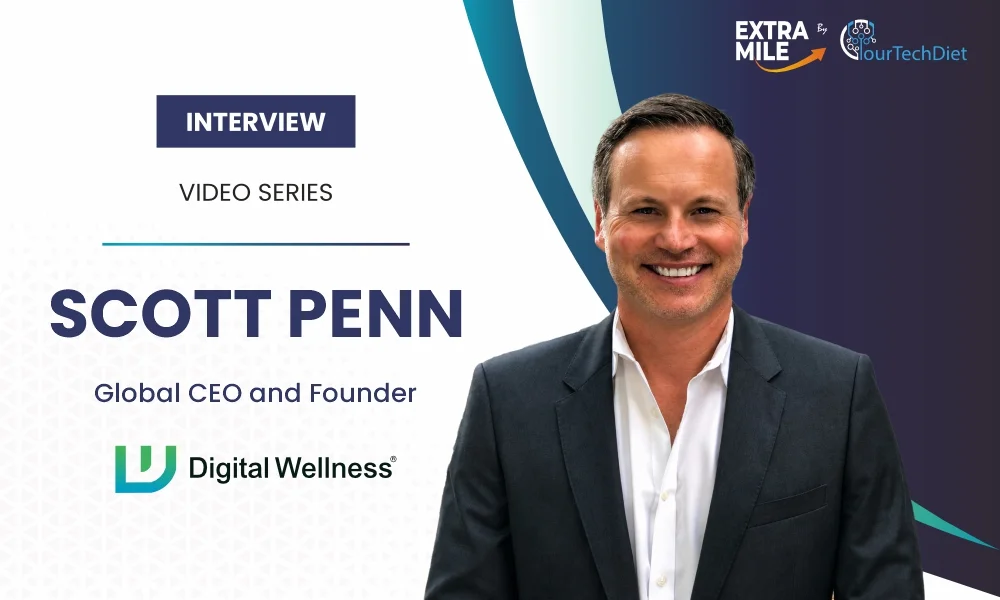
I’m your host, Rittika, and for today’s conversation, we are accompanied by Scott Penn, the Global CEO and Founder of Digital Wellness. The firm focuses on improving people’s health and wellbeing while integrating the latest tech. Scott has been a key contributor to Digital Wellness’ advancements over the years.
With the platform, he aims to turn clinical research into practical, data-driven behavioral change to fight the global obesity epidemic. So, let’s get started and learn more about Digital Wellness, AI-driven health technology, the advantages and risks of AI-enabled healthcare, the rise of personalized wellness, and more.
So welcome, Scott. Hope you’re doing fine today. Glad to have you here.
I was running Asia-Pacific and on the global executive. So, I had a front-row seat for a number of things. The best part of it was at the time, we had just been acquired by a private equity group who had a, and collectively, we had a really clear six-year plan.
So, a clear plan was a fundamental part of the success. So, a clear plan, it was six years. We had an aligned management team so that management team knew exactly what we needed to achieve over that time period.
And we also were very focused on knowing our customers in terms of understanding who we were attracting to the business, understanding what they really wanted from us, and then making sure we delivered product innovation that gave the end consumer what they needed. In that case, obviously, it was about losing weight, but it really wasn’t. You know, the business was founded in 1963 by Jean Nidetch, and she had a very clear philosophy of what she wanted.
And the main business at that stage was a group support meetings business where people sat around the room and talked about what they’re reading, how they’re feeling, what challenges they had. We didn’t deviate too far away from that, certainly in the early time, to make sure that we were delivering what people were looking for. And interestingly enough, you know, it was a six-year plan.
The focus was to IPO, to go public after six years. And we actually achieved that in 18 months. So effectively doubled the business in 18 months and went public not far after that.
So, it was a pretty phenomenal.
Host: Yeah, that was absolutely amazing. So, moving ahead, with GLP-1 medications dominating the market, do you think chemical suppression completely fails without foundational behavioral software? If so, then why?
Scott: Yeah, I wouldn’t say it completely fails. I would say that it’s just not optimized. And I think the studies that are coming out now, the products being in market for a number of years are demonstrating that without behavior change in particular, people are putting the weight back on once they finish medication.
So, the optimal outcome for everyone would be really just to match the clinical trials. So, every clinical trial of weight loss medication to date has been done with a combination of the medication, a behavior change program and a health professional. So, there’s three elements that have been foundational for those amazing weight loss results that they’re getting in the clinical trials.
But in the real world, what’s happening is that the medication is just being prescribed alone. So, in the real world, we are not seeing the phenomenal results of the clinical trials we’re showing. Look, and there’s a lot of behavioral pieces behind that.
There’s environmental, there’s access to the medication in terms of from a cost point of view. So, there’s a number of factors influencing that. However, the clinical trials had a behavior change program prescribed to every single person.
And what I believe is that that should be happening in the real world as well. So, for these medications to truly work long term, they need to be prescribed with a behavior change program.
Host: Totally agreed. Such medications show the clinical trial results. Foundational behavioral software are unignorable. So next up, many health apps depend heavily on gamification. In the wellness space, when does app gamification stop giving healthy engagement and start triggering harmful user behavior?
Scott: I mean, gamification is a good thing on the whole in terms of because it drives engagement. So certainly, in the health and wellness area, engagement is key. So, for people to truly get the health outcomes they’re looking for, they need to stick with it and keep coming back.
So, gamification can definitely help achieve a lot of that in terms of your notifications, your reward systems or your leaderboards and things like that. That style of gamification is actually beneficial for sort of health and wellness apps in particular. But I guess like anything, if it becomes obsessive and gets overused, it obviously or if it’s not used in the spirit that it was designed in the first place, then it could have a not a great outcome.
But certainly in the health and wellness space in particular, gamification is very useful because what we’re trying to do is build new habits for people or get them to adopt healthier habits. And so, if the gamification side of it can actually encourage people to be more involved and get engaged with the app, then I think it’s a positive thing.
Host: Yeah, app gamification should aim to drive positive engagement. So, approaching further, Digital Wellness manages massive behavioral data while impacting over three million lives. How do you maintain a balance of utilizing data for hyper-personalized insights and prioritizing a zero-trust privacy posture?
Scott: Yeah, look, I mean, from a security point of view, maintaining data privacy is absolutely paramount. I think we are somewhat obsessed with it at Digital Wellness to make sure that all of our staff have regular monthly training, all of our vendors, we make sure that everyone has all the certification and the like. So, security is paramount.
I think what we are able to do also is we’re able to segregate certain parts of data to experts. So obviously from a payment processing piece, we leave that with experts. So, we have no access to that.
It APIs into our system, but we don’t access that. And same with PHI. We make sure that experts who have segregated on different servers have access to that, and we get de-identified data.
So, the most important thing for us is making sure that there’s no risk of customer data being surfaced. We manage some really important data ourselves in terms of their activity, using our platform, what recipes they’re using, what menu plans, how much activity, etc., etc. That’s all incredibly useful.
And we surface that information back up to the user or the member. And so that data is important because we’re trying to build that engagement. We’re trying to give them insights as to what positive behavior are they doing, what other things could they could they change, what other information could they utilize to truly help them change their behavior long term.
So, it’s just getting the balance right. It’s making sure that we protect information that we definitely wouldn’t want anyone else to see. But we also surface the information that they need to help them truly drive their behavior change.
Host: Yeah, it’s truly amazing to know how Digital Wellness is balancing data privacy alongside offering unmatched insights while it comes to digital wellness. So, generative AI dominates digital coaching at present, but there are also ethical concerns. How does Digital Wellness build trust among users while designing AI-driven health technology solutions?
Scott: Yeah, that’s a good question because it’s certainly something that everyone’s thinking about right now. I think for us, we’re really clear on what content we want to deliver to our members. So, we really stay in our lane on that.
So, we’re not we don’t give medical advice. We have an amazing content library. We use AI to help us surface that data more in a more personalized way to each individual.
We also then ingest their data that in terms of how they’re using the platform and certainly how they’re actually performing on any of our programs. And then we optimize that using both machine learning and AI to surface it back to them in a personalized way and in useful bytes that help them use the program better. So, it’s all about optimizing the program ultimately.
So, but the important thing is we need to stay in our lane as to what is the right information to give them and not go outside that lane in terms of doctor’s advice or specialist advice that isn’t our right. We then suggest that they go back to their doctor to get specific medical advice.
Host: It is amazing to know how you are addressing the ethical concerns while leveraging AI models. So next up, how is AI different from human health coaches and what advantages and risks will AI unlock in the future of healthcare and wellness?
Scott: Yeah, look it. I mean, obviously they are quite different in terms of inputs and outputs. I mean, a humanistic level, you can make an emotional connection with other humans.
So, I think it’s, you know, from a coaching point of view, you’re just having that face-to-face communication, being able to engage using your eyes, make facial expressions. There’s definitely an emotional connection that you can make as a human that AI will not replace anytime soon. So, I think there’s definitely and also there’s personal experience involved in human coaching that the individual may have been through an exact same need state that you have.
And so, making that emotional connection is a great thing. Having said that, AI is incredibly complementary in a number of ways because AI can crunch data really quickly. It can create outcomes quickly.
It can use massive data sets that an individual may not be able to do themselves to provide a better outcome for people. So, I think using the two in combination is the crucial part here so that you can make the emotional connection, you can use your own experiences and help guide people based on those experiences. But then it’s using AI to your advantage, both from a data point of view, a historical point of view, using large data sets of similar people, for example, and saying, well, someone of your age, of your style living in this area are able to do these things.
Maybe that’s something you might consider. So, I think there’s definitely a positive advantage to AI in surfacing information. It’s then how that’s used.
And it’s how the individual, if you’ve got a human coach, how that coach can use that information to help motivate you to actually make positive change.
Host: AI surely has some key advantages, but it is important as well to have human surveillance upon that. So, let’s proceed further. The wellness industry has evolved from in-person meetings to digital platforms and now to highly fragmented digital ecosystems. How do you determine whether new technology is just a temporary trend or a major change that seeks a significant shift in your business strategy?
Scott: Yeah, I think it’s fair to say that technology is here to stay. So, it’s then about how do we use it to our advantage in the wellness, in the health and wellness space? I personally, I’m a big believer in democratized healthcare in terms of the people at the end of the day, it’s your body, it’s your, they’re your records.
You should be able to determine how those records are used. You should be able to determine what information you want to help you make the best decision for you. So, I think we will see an increase in democratized healthcare over the next decade, where the individual is in the center of the healthcare journey.
Right now, that’s starting to happen. But medicine in particular has been importantly driven by health professionals. But I think it’s about having a balance.
Because at the end of the day, if you’re told to do something by a health professional and you don’t do it, well, that’s on you. So, I think what we need to work through is how do we help people take more individual responsibility for their health? Because no one can actually do it for you.
Now, medication can do certain parts for you. Your health professional can do certain parts for you. But you still need to, ultimately, you’re responsible for your own health.
So, I think that’s going to be an interest. It’s going to be interesting to see how technology can help people. That’s certainly what we do at Digital Wellness.
We certainly are about helping people, which we want to help people change their lives for the better. And technology helps us enable people to do that. So, I think that’s my hope, is that technology can help enable that.
And I do believe that everyone deserves to live a healthy life. So, if technology can keep helping enable that for people, I’m all in.
Host: Totally agreed. As you said, technology is going to stay. And it is our responsibility to use it in a positive way and stay healthy. So lastly, personalized wellness has become more than a trend today. How is it changing the dynamics of health and wellness? And in your opinion, which advancements will be significant for personalized wellness in the upcoming decade?
Scott: Yeah, so I think it’s really important. I just mentioned before sort of democratized healthcare and individual responsibilities. So, I think the advancements of technology and AI will help enable that more.
So, when I talk about democratized healthcare right now, a lot of, I mean, we talked about the privacy concerns and data security earlier. That is an absolute fact. Yes, we want to make sure that we keep any personal records safe from a privacy point of view.
But there is a cost to that, which is then you have health professionals who can’t share data with other health professionals. So as a system, if more people had access to your entire healthcare portfolio in terms of understanding what happened when you were eight years old, what happened when you were 15 years old, what happened when you were 30 years old and understood and could actually link all of those pieces, we would have a much better healthcare outcome around the world. But right now, that’s not possible due to privacy and due to people having records in disparate places.
So, when you are eight, you probably have a different doctor than when you’re 15, you’re 30, you might be living in different parts of the world. So, you don’t, so you just don’t have that continuity of care. So, I think if there’s something that could be an advancement in personalized wellness over the next decade, it’s absolutely that care continuum, having records that you personally are in control of, that you allow to be shared with other people to make sure that you have a better healthcare outcome.
I mean, we do it with social media. A lot of people use social media as kind of their electrophoto library, right? And that allows them what they’ve shared with their friends and family in the world.
They’ve put out there all the great events that they went to, all the family events they went to, their kids growing up. So, everyone’s very comfortable sharing that data. It’s data at the end of the day.
But sharing those images and data, quite personal images and data, they’re sharing those on Facebook and other platforms. So, I guess that’s very personal data. Now, I know your healthcare data is very personal data, but if people are comfortable doing it, why wouldn’t we also have to be careful that there’s a way to police it and still keep a level of privacy around it?
But there’s definitely an end benefit of the individual being responsible for their own records and being able to share them with whoever they want to. I think the end benefit would be a much healthier world.
Host: Totally agreed. Personalized wellness surely depends on the data we share. And it is surely reaching new heights with technologies like AI, machine learning, wearable devices, and predictive analytics.
So that’s a wrap, Scott. Thank you so much for joining us and sharing how Digital Wellness is redefining healthcare. So, your perspectives reflect how exciting the future of personalized wellbeing is.
And when technology and data comes together, then we can hope for a more personalized digital care and wellbeing. So, thank you so much.
Scott: Pleasure. Thanks, Rittika.
Host: And to our viewers, thank you for being a part of this insightful conversation of ExtraMile by YourTechDiet. Stay tuned with us for more expert-led interviews. For now, keep exploring and learning.