
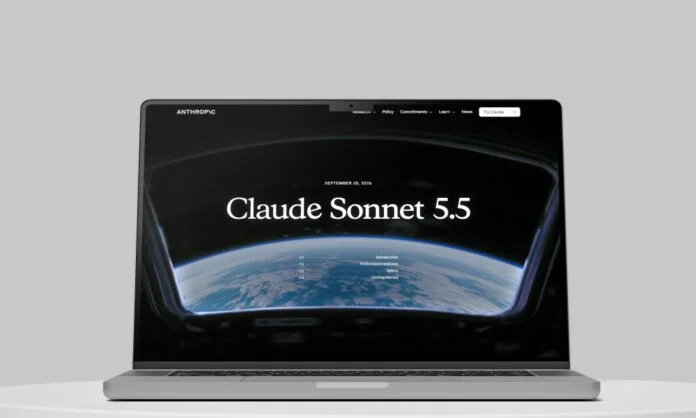
Anthropic has introduced Claude Sonnet 5.5, its latest Sonnet model focused on speed, coding, and everyday knowledge work. The company claims that the model generates outputs more than 30% faster than Claude Sonnet 5. Additionally, the model can cost up to 30% less per task. Released on September 28, 2026, the model is positioned between Anthropic’s higher-end Opus 5.5 and upcoming Haiku 5.5.
As Anthropic states, “Introducing Claude Sonnet 5.5, the second model in the Claude 5.5 family. It’s a clear upgrade over Claude Sonnet 5, runs 30%+ faster, and costs up to 30% less for most work.”
The latest model focuses on improving crucial capabilities over its predecessor, including performance, collaboration, cost, speed, alignment, and safety. The new model keeps the same token pricing as Sonnet 5. It costs $2 per million input tokens and $10 per million output tokens. Cache reads cost $0.20 per million tokens.
Claude Sonnet 5.5 Offers Faster Performance with Lower Task Costs
Sonnet 5.5 is Anthropic’s fastest Sonnet model so far. Its efficiency also comes from using fewer tokens for many tasks. The model can cost up to 30% less per task than Sonnet 5. The savings do not come from lower token prices; rather, they come from completing work with fewer tokens.
Nevertheless, actual costs can differ based on task complexity, output length, caching, and the selected effort level. Independent testing also shows that token usage can differ across workloads. The model supports a 1-million-token context window and up to 128,000 output tokens. It uses adaptive thinking, with high effort set as the default on the Claude Platform.
Coding Reaches the Next Level:
Coding is one of the areas where Anthropic reports a major performance increase within Sonnet 5.5. It scored 70.6% on Terminal-Bench 4.0, compared with 10.3% for Sonnet 5. The benchmark measures complex, multi-step tasks performed through a command-line environment.
On CursorBench 4.0, Sonnet 5.5 scored 55.5%, compared with 34.1% for Sonnet 5. Anthropic also reported a 46.2% score on FrontierCode at Max effort. GitHub has already made Claude the model generally available in GitHub Copilot, targeting everyday development tasks, including building features and fixing bugs.
Improved Knowledge Work Capabilities:
Anthropic has also targeted Sonnet 5.5 at documents, presentations, spreadsheets, and other knowledge-work tasks. The model scored 1,844 on GDPval-AA v2.1 while Sonnet 5 scored 1,449 and Opus 5.5 scored 1,846 on the same benchmark.
The company highlights that the early testers found limited quantifiable improvements; however, they traced a focus on design. Alongside that, the model also polishes user interfaces while following slide templates to create decks that require minimal editing. Apart from that, internal tests show that the model can generate share-worthy presentations and documents.
Advanced Cybersecurity Safeguards
Claude Sonnet 5.5 also introduces additional safeguards because of its stronger cybersecurity capabilities. The model launches with cyber safeguards and fallback mechanisms developed for its more capable models. In this regard, higher-risk cybersecurity requests can trigger additional restrictions.
Routine software development remains available, including common coding and debugging work. Anthropic shares that the model retains the same biology safeguards used with Sonnet 5. The company has also introduced safeguards against large-scale attempts to extract model reasoning through distillation techniques.
Availability of Claude Sonnet 5.5
Claude Sonnet 5.5 is available through Claude, the Claude API, Amazon Web Services, Google Cloud, and Microsoft Azure. Developers can access the model using the model identifier claude-sonnet-5-5. GitHub Copilot users can also access Sonnet 5.5 across supported products and development environments. The rollout is gradual for some Copilot users.
Anthropic said Claude Haiku 5.5 will join the Claude 5.5 family in the coming weeks. The company positions the upcoming model for high-volume and cost-sensitive applications.
Learn about the latest AI models and industry breakthroughs, only with YourTechDiet!
Read More : AI Copilots Explained: How Digital Coworkers Are Changing Enterprise Work