
Google makes significant advancements in image and video generation models with the launch of Nano Banana 2 Lite and Gemini Omni Flash. The former becomes the fastest and most cost-efficient Gemini Image model while the latter simplifies high-quality video generation and conversational editing. The models were officially announced on June 30, 2026, enabling developers to experience thorough, end-to-end multimedia.
As stated by Google, “Building with generative media is often about creative iteration. With these two models, developers can build comprehensive, end-to-end multimedia experiences that connect rapid image generation with video creation and editing.”
Both models aim to advance your creative workflows, allowing you to generate thousands of images and edit multi-turn video sequences faster and more efficiently.
Nano Banana 2 Lite:
Nano Banana 2 Lite or Gemini 3.1 Flash Lite Image is designed to overcome latency in image-to-text outputs. Additionally, it offers cost efficiency like never before, allowing 1K-resolution image generation for just $0.034.
It is the fourth model of the Nano Banana family that prioritizes speed, reliable prompt adherence, advanced character consistency, and understandable in-image text rendering.
Gemini Omni Flash:
Gemini Omni Flash was introduced at Google I/O 2026 and is now rolling out to developers through the Gemini API and Google AI Studio. The model excels in high-quality video generation and conversational editing. Additionally, it supports multimodal reasoning with the ability to process text, image, and video inputs.
Gemini Omni Flash integrates real-world knowledge, such as history, biology, and narrative logic, to generate intuitive videos. Furthermore, it enables text and action synchronization via simple prompting.
Nevertheless, Gemini Omni Flash has its own limitations. Currently, it allows 10-second video generation. Users cannot upload audio references and scene extensions as of now in the Gemini API. Apart from that, character consistency also has certain limitations when changing scenes.
Benchmarks Achieved:
Nano Banana 2 Lite (Gemini 3.1 Flash Lite Image)
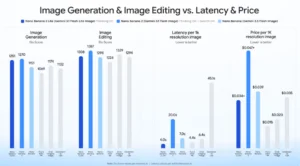
The model advances image generation and editing while reducing latency and cost per 1K-resolution image. Here is a comparison of Nano Banana 2 Lite with the previous models:
Source: Google
Gemini Omni Flash
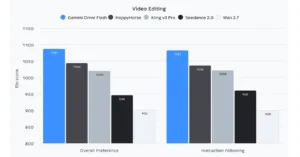
The model reflects exceptional instruction following, alongside multimodal referencing and real-world knowledge. Here is a comparison of the model with the leading video generation models:
Source: Google
Availability of Nano Banana 2 Lite and Gemini Omni Flash:
Nano Banana 2 Lite is currently available on Google AI Gemini API and the Gemini Enterprise Agent Platform. It is also accessible across Google’s front-end experiences such as AI Mode, the Gemini app, and others.
Gemini Omni Flash is available in Google AI Studio, Gemini API, and Gemini Enterprise Agent Platform. Additionally, the model is available in the Gemini app and Google Flow.
Google highlights how using Nano Banana 2 Lite and Gemini Omni Flash together can advance your creative workflow, combining high-speed image and high-quality video generation. The Interactions API makes the multi-turn experiences more exciting by enabling the ability to maintain session history and context with which users can stack up to three sequential edits.
Like other Google AI models, the new models are built with safety and transparency at the center. They use SynthID watermarking so that users can easily differentiate between original and AI-generated content.
Visit us at YourTechDiet and stay aligned with the significant tech breakthroughs driving transformation in diverse industries!
Our Latest Blog:
DiscoGAN vs CycleGAN: Differences, Pros/Cons, and Current Relevance