
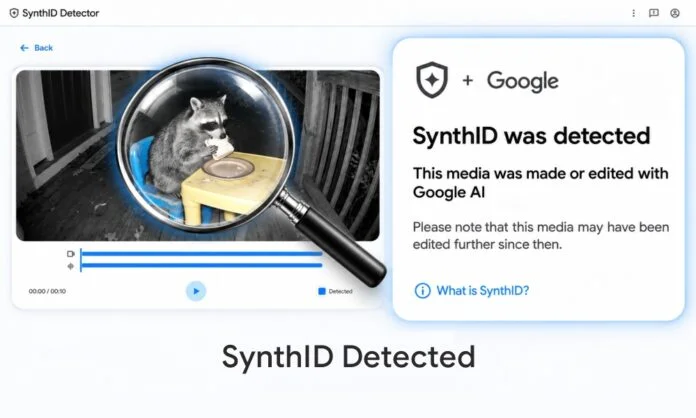
Google simplifies detecting AI-generated content for all users by announcing the general availability of its SynthID Detector. Users can now check images, videos, and audio for invisible AI watermarks and determine if they are AI-generated. With the announcement made on October 7, 2026, Google has made it clear that alongside the easy use of AI tools, it is also important to identify AI-generated content while making informed decisions.
The company introduced the digital watermarking system, SynthID, in 2023 to help people easily detect AI-generated content. Later in 2025, SynthID Detector was launched to track invisible watermarks across images, videos, and audio created with Google AI. However, its availability was limited to media professionals only. Google now takes a step ahead and makes the AI-generated content detection tool publicly available for everyone.
Users can upload supported media to the tool directly to check whether it carries a SynthID watermark. The system can accordingly identify content created or edited using Google AI and participating partner tools.
SynthID Goes Beyond Google AI
SynthID is Google DeepMind’s watermarking technology for identifying AI-generated content. It embeds invisible digital signals into generated images, videos, audio, and text. For images and videos, the watermark is designed to survive common modifications, including cropping, filters, frame-rate changes, and lossy compression. Audio watermarks are also designed to withstand changes such as noise, MP3 compression, and speed adjustments.
The public detector currently supports SynthID watermarks from Google and several partners, including OpenAI, NVIDIA, and Kakao. Google also hints that Apple support is coming soon. According to Google, the system has watermarked more than 180 billion images and videos since SynthID launched, alongside marking about 240,000 years of audio content. SynthID Detector can now help all users easily identify these content types.
SynthID Detector Does Not Identify Universal AI Content
Notably, the general availability of SynthID Detector does not make it a general-purpose AI detector, as the system depends on the presence of a SynthID watermark from supported providers. AI systems that create content without using SynthID may therefore return no watermark. In this regard, a detection result can indicate content was made or edited with supported AI.
Google’s step to make the AI content detection tool generally available is significant as AI-generated media sharing becomes increasingly common online. Stay updated with crucial tech advancements and announcements, only with YourTechDiet.
Read More : AI Copilots Explained: How Digital Coworkers Are Changing Enterprise Work