
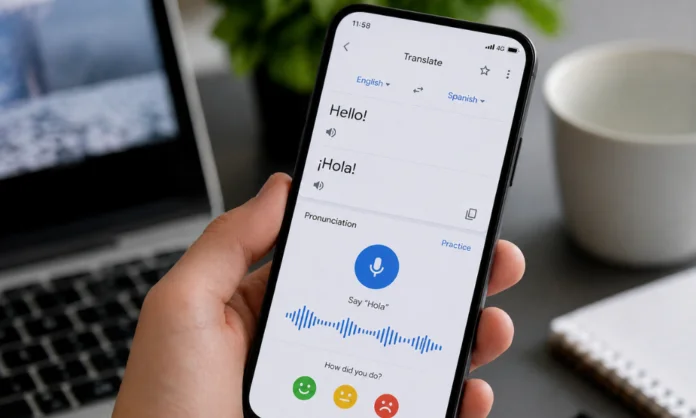
Google has introduced a new AI-enabled Pronunciation Practice feature in Google Translate that aims to help users improve their spoken language skills. The integration was announced on April 28, 2026, on the occasion of the application’s 20th anniversary. Google has additionally shared 20 tips to use Translate more effectively. Currently, the feature is rolling out on Android devices while offering real-time speaking feedback to users.
The Gemini-enabled pronunciation practice feature allows users to speak translated phrases and receive instant feedback. The tool uses AI to analyze how closely a user’s speech matches native pronunciation. Apart from that, the system is also capable of highlighting mispronounced words while suggesting improvements.
The feature works through interactive exercises. So, users can repeat phrases and track their accuracy over time. Such capabilities turn Google Translate from a simple translation tool into a more active learning assistant.
How Does the AI Pronunciation Practice Feature Work?
Primarily, users translate a phrase into their preferred language. Once the output appears, users can click the practice option to begin speaking exercises. The app accordingly listens to what users say and evaluates pronunciation using speech recognition and AI models.
As per Google, the feedback is designed to be simple and actionable. As a result, the app highlights where users require improvement instead of complex phonetic analysis. Such an approach makes Google Translate’s AI Pronunciation Practice feature helpful for beginners as well as experts.
Notably, the feature is currently supporting selected languages. However, users can anticipate a gradual expansion of languages in the upcoming months, considering its performance and demand.
How will the Feature Help Users?
The new feature can be remarkably beneficial for travelers, professionals, and students who require language support to execute their tasks. Whether translating languages or learning how to pronounce words in different languages, Google Translate makes it all available in one application. So, users now do not need to switch between apps to translate and practice languages.
The rollout also reflects a wider trend of AI tools becoming more educational. For this purpose, Google is taking active initiatives to close the gap between understanding a language and speaking it by combining translation with feedback.
Significantly, Google Translate has evolved beyond text conversion into a broader communication tool over the years. Hence, the Pronunciation Practice feature update reflects how people increasingly use Translate for learning, not just quick translations. This may also make the tool a complete language partner for users traveling across borders and learning new languages.
YourTechDiet delivers key tech insights and news so that you stay informed. Follow our content updates and never miss any opportunity to learn about major innovations.
Also Read:
Multilingual AI: The Future of Translation and Global Communication