
The e-commerce market is growing at the fastest rate today amid global digitization. Visiting shops to make purchases has become a rare scenario. However, there are certain factors that contribute to the success of online sales.
Some of them include an easy-to-navigate website, catchy CTAs, product images, and how can we miss out on placing the different payment gateway options on the website to add convenience to a customer’s buying journey?
Yes, integrating a payment gateway for your eCommerce store website is the easiest way to accept payments, improve customer experience, and boost online sales. According to recent data, the global payment gateway market is expected to reach $160 billion by 2032.
This blog takes you through everything around the payment gateway and how incorporating it on your website can increase your eCommerce growth.
What is a Payment Gateway?
To put it simply, the payment gateway is a digital tool that is mainly used by businesses today, as there is a significant shift towards digital payments. This type of payment is done through UPI, digital wallets, electronic bank transfers, and more.
It cuts down the barrier of handling manual cash or checks, allowing you to make payments from anywhere at any time globally. Businesses today increasingly integrate payment gateways for their website to make transactions easier and more secure for customers.
Types of Payment Gateway
Following are the major types of payment gateway integration. Here we have mentioned them:
Hosted Payment Gateway:
This type of payment gateway redirects the customer to a third-party payment processor page to complete the transaction. The main benefit of a hosted gateway is easy integration and robust security.
API Payment Gateway:
This is the most common type of payment gateway used widely. Here it allows businesses to process online payments by connecting their website or application to the payment processor with an Application Programming Interface (API).
Examples:
- Stripe API
- Razorpay API
Benefits of Integrating Payment Gateway on Your Website
If you are still confused whether to integrate payment gateway to your website for boosting your online sales, check out the benefits listed below:
Faster Payment Processing-
You don’t need to wait in line to get the payment made. Integrating website payment gateways makes it easier and faster for the customers to make the payment in just a few minutes, improving satisfaction, and bringing them back to your website. In short, it is a positive sign of improving your sales.
Saves Your Time and Efforts-
Manual updates are time-consuming and tedious. However, website payment gateways make it simple. It can be integrated directly into your account or invoices. Thus, if an online payment is done, the details are updated right away, saving you time and effort.
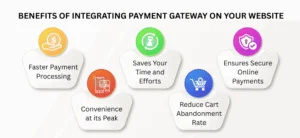
Ensures Secure Online Payments-
The online payment gateways abide by the PCI-DSS compliant and fraud protection systems. Alongside, they follow other security measures such as SSL/TLS encryption, tokenization, and more.
Convenience at its Peak-
While making online payments, you have a lot of options. You can choose one at your convenience. The standard options are:
- Debit/credit cards
- Net banking
- UPI
Reduce Cart Abandonment Rate-
Often, customers purchase the product but find the checkout process lengthy, so they leave the cart. However, payment gateways offer quick checkouts without making you wait long.
Checkout Experience and eCommerce Growth – How Are They Related?
One of the most prominent factors that will lower cart abandonment is a smooth checkout experience, and a properly integrated payment gateway is a significant contributor to it. The autofill features, reduced number of clicks, payment frameworks, and quick processing will allow customers to make purchases more easily, resulting in increased conversions and overall customer satisfaction.
Tips to Choose the Right Payment Gateway for Your Business
The payment method would not be the same for everyone. You need first to analyze which works best for your customers, their expectations, and most importantly, your business.
A Startup Business:
A hosted gateway would work best in this scenario—budget-friendly and easy integration.
A Scaling Business:
An API-hosted gateway is an ideal choice if you have a growing business and are looking for a scalable payment solution with top security and payment features.
Popular Payment Gateway Providers
The most trusted and developer-friendly API is opted for by millions of businesses to accept online payments. It offers features such as online payments, buy now, pay later, accounting support, and multi-country payment support, making Stripe the right choice for launching your eBusiness at scale.
PayPal is a globally recognized brand that allows customers to make fast and secure payments, check out in just one click, and has widespread acceptance in the marketplace, allowing merchants to increase their conversion rates.
Wrapping It Up
Here we come to the end of the blog! It’s clear that payment gateways are a key pillar for boosting your eCommerce sales growth. Integrating them on your website makes the payment process smooth, secure, and super-fast.
It’s the need of the hour to evolve with the digital world. Thus, enhancing checkout experience, mobile payment integration, and more such factors together contribute to meeting the end sales goal. Integrate and test the best payment gateway for your website and watch your sales soar.
For more such trending blogs, visit us here!
Frequently Asked Questions
1. What is a payment gateway in e-commerce?
Ans: A payment gateway is a secure digital technology that particularly processes online payments between customers and eCommerce businesses.
2. Why do e-commerce stores need a payment gateway?
Ans: It offers fast, reliable and secure online transactions that help to improve the overall conversion or sales rate.
3. How can I choose the right payment gateway for my business?
Ans: There are several factors to consider before choosing the right payment gateway, including fraud prevention, fees, additional security measures, mobile payment integration, and more.
Recommended reading: