
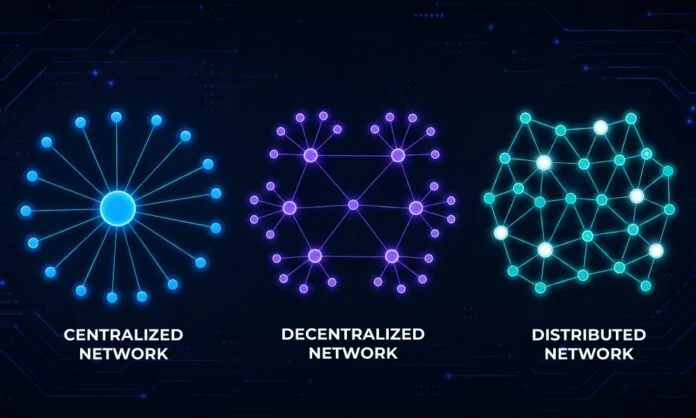
We use phones and computers every day, but have you ever wondered how the information on the devices is delivered? A network connects these devices to communicate and share resources through wired or wireless mediums. This communication is possible with the different types of network architectures that determine how networks connect and exchange data.
The three main types of network architectures are centralized, decentralized, and distributed networks.
We will learn about the advantages and disadvantages of each network. Then we’ll compare all three networks to determine which network you should implement in your business.
Without further ado, let’s get into it!
Defining Centralized Networks
In a centralized network, all nodes are peripherally connected to a single central server. This central server manages the storage, communication, and processing of data within the network.
A centralized network is the most common type of network and is used by websites like YouTube, banking sites, app stores, etc. It is not complex by nature and is easy to manage because it only has one point of control.
Advantages of Centralized Networks
- Simplified task assignment and deployment: Centralized networks enable easy task allocation, as the main server can communicate directly with attached nodes, reducing the need for constant communication between computers.
- Cost-effective network solution: For small businesses, maintaining a single central server is easier than multiple independent systems. It is also easier to install, as less equipment and time are required to run the system. All these factors reduce the cost of installing and maintaining the network.
- Easier security: Patching or updating the network only involves the main server, simplifying security processes. Security threats, regulatory violations, errors, etc., can be detected and resolved more easily because all information is centralized.
Disadvantages of Centralized Networks
- Central server dependency: The central server is the most important component of a centralized network, where the main processing takes place. If it crashes, the entire system will stop functioning.
- Increased security vulnerability: In a centralized network, attackers may target the main server, compromising the entire system. It is especially vulnerable since all the important information and processing happen in one location.
- Limited operational capacity: A finite number of users can join a centralized network as the server reaches a limit. Expanding storage, bandwidth, and processing power can be costly and introduce latency in the system.
Defining Decentralized Networks
Decentralized networks, unlike centralized networks, don’t rely on a single server. They consist of multiple interconnected smaller networks, each with its own central server.
This type of network reduces dependency on a single central server. If one server crashes, the other servers in the network can still continue processing data.
Advantages of Decentralized Networks
- Utilization of multiple servers: Decentralized networks can continue functioning even if one server fails, since they operate via multiple servers.
- Quicker user results: A decentralized network delivers faster results to users, as master nodes can be deployed where network traffic is highest.
- Better privacy: Decentralized networks provide information without revealing the source of the data. This type of network also allows users to only share credentials they want to instead of being forced while creating accounts.
Disadvantages of Decentralized Networks
- Decreased communication: Nodes in a decentralized network may not always share information with other nodes because they operate independently. This can make communication within the network difficult.
- Complex maintenance: There are more systems to monitor, update, and maintain in a decentralized network. This increases the cost and complexity of maintaining the network.
Defining Distributed Networks
Distributed networks may appear similar to decentralized networks because they consist of multiple servers rather than a single main server. But in a distributed network, nodes are evenly distributed and connected to each other.
All the systems in a distributed network communicate with each other to process a common objective. This means the goal of this network is to improve performance rather than share power.
Advantages of Distributed Networks
- Better fault tolerance: Since the nodes in a distributed system are not dependent on a central server, if a node fails, its workload is redistributed to the other nodes. So, this network handles failures much better than other networks.
- Improved speed: Distributed networks experience lower latency than the other two networks because their nodes and processing power are evenly distributed across the network.
- Enhanced security: Data is stored in multiple nodes in this network. An attacker would need to hack many nodes to change or delete information, thereby increasing network security.
Disadvantages of Distributed Networks
- Difficult debugging process: Each node in a distributed network maintains its own clock. This makes it difficult to detect which event occurred first in case of a bug, making it harder to fix.
- Lack of hierarchy: Since this network lacks a hierarchy, it is more difficult to control and coordinate within it. This makes it harder to make decisions and manage large tasks.
Comparing Centralized, Decentralized, and Distributed Networks
Now we know what centralized, decentralized, and distributed networks are. The key difference among them is how the networks are structured. This refers to whether they have a single central server or multiple servers, and whether those servers are evenly distributed. Here are more ways to differentiate among centralized, decentralized, and distributed networks:
Aspects |
Centralized Networks |
Decentralized Networks |
Distributed Networks |
| Storage | All data is stored on the main server. | Data is stored on multiple independent nodes. | Data is stored and organized through partitioning and replication processes. |
| Speed | Provides faster results due to a simplified structure. | Slower than centralized networks due to data validation processes. | Speed dependent on parallel processing and network latency. |
| Scalability | Scaling involves updating the central server. | More nodes are added to the network. | Scaling is done by distributing work processes across the systems. |
| Vulnerability | High vulnerability because of a single point of failure. | Less vulnerable than centralized because of multiple server processing. | Least vulnerable among all networks due to the storage of data among multiple nodes. |
| Applications | Streaming services, online banking systems, corporate intranets, etc. | Peer-to-peer data sharing, blockchain networks, decentralized social platforms, etc. | Cloud computing, edge computing, Content Delivery Networks, etc. |
In Summary
Hopefully, you now know the structures involved in delivering the information behind the devices. You must have come across centralized, decentralized, and distributed networks while sending emails or sharing files through the cloud and through other internet processes.
But which network should you adopt that suits your business the best?
Small businesses should implement centralized networks as they are easy to install, maintain, and are cost-effective. Growing businesses with multiple branches across the globe should implement decentralized networks. This type of network offers better security and eliminates the issue of a single point of failure. Distributed networks work best for high-tech enterprises as they provide the lowest latencies, maximum fault tolerance, and are highly scalable.
It is important for companies to weigh the pros and cons of each network before implementation. This will enable informed decision-making and lead to successful, efficient work results.
You can find more interesting tech content on our website, YourTechDiet.
FAQs
1. Is the Internet a centralized network?
Answer: The internet infrastructure is decentralized, but the services and content are centralized.
2. Why do banks use centralized frameworks?
Answer: Banks follow centralized frameworks for regulatory compliance, unified customer experience, and operational efficiency.
3. Which network is ChatGPT built on?
Answer: ChatGPT is built on a large, complex distributed network.
Recommended For You:
Decentralized Web: The Future of the Internet?
Difference Between Centralized Computing System & Distributed Computing System