
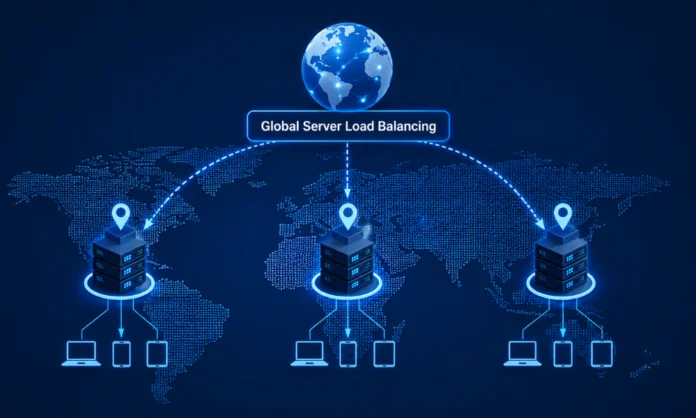
In today’s IT environment, where businesses are expanding geographically, there is a need for higher availability and reliability when it comes to online presence. Websites and applications are key drivers of business success, and even a few seconds of downtime can be costly. The answer to this challenge is global server load balancing, which intelligently routes incoming traffic across multiple servers, data centers, or cloud environments located in multiple geographic regions.
This global deployment comes with a range of benefits, such as higher performance, lower latency, and faster response times, as users can access websites or applications from their nearest data center. To help you understand better, this blog explains the core concepts of global server load balancing, along with its benefits, use cases, and more. Let’s get started.
What is Meant by Global Server Load Balancing (GSLB)?
Global server load balancing is a practice of distributing traffic across servers worldwide to enhance efficiency and availability. It is built on core load balancing techniques to manage the steady flow of traffic across multiple data centers and cloud providers.
GSLB redirects traffic to the best possible servers, with lower congestion or those nearest to users, enabling faster, more reliable response times for websites. It differs from standard or local load balancing, which manages traffic within a local network. Industry reports reveal that global load balancer market size was valued at $5.9 billion in 2023 and is expected to grow from $8.6 billion in 2026 to $16.1 billion by 2030. The main goal of the GSLB system is to boost website or application performance and availability.
How Does Global Server Load Balancing Route Traffic Across Multiple Regions?
Global server load balancing uses intelligent algorithms and policies, including DNS-based network routing, to route user requests to the most suitable server based on geographic location, network latency, server health, and network conditions. It manages and balances user requests across multiple regions.
For example, when a user requests access to a website’s content from a server, GSLB understands which server or data center should deliver the content or provide the service.
GSLB vs Local Load Balancing: Differences to Know
Check out the key differences between global server load balancing and local load balancing.
Global Server Load Balancing |
Local Load Balancing |
| Manages traffic across multiple data centers worldwide | Manages traffic within a single data center or particular region |
| Complex to set up and manage | Can be set up and managed easily locally |
| Higher cost as it includes the global infrastructure | Lower cost as it includes the local infrastructure |
| Location, latency, server health, capacity, and routing policies | Capacity, server health, and response time |
| Ideal for customers in multiple geographic locations | Ideal for applications serving customers in a particular region or location |
What are the Benefits of Global Server Load Balancing?
Below are some key advantages of deploying geo load balancing strategies for your organization.
- An improved user experience: By routing traffic to the nearest server, GSLB reduces latency and improves response time, boosting customer experience.
- Higher availability: GSLB automatically reroutes network traffic to minimize downtime and keep the network operational 24/7.
- Compliance: Global server load balancers can be easily configured to comply with regulations and security requirements in regulated industries like defense, healthcare, and more.
- Improved functionality for current load balancers: One of the key geo load balancing strategies is integrating GSLB with existing load balancers and boosting their capabilities.
Effective Methods of GSLB: DNS-Based Routing, Anycast, and Latency-Based Routing
GSLB solutions use various load-balancing methods to deliver appropriate responses.
- DNS-based traffic routing: Domain Name System (DNS) intelligently distributes incoming network requests across several servers or data centers.
- Content Delivery Networks (CDNs): GSLB directs users to the right server within a CDN using the GSLB method.
- Anycast routing: A network-layer approach where multiple servers share the same IP addresses across different locations.
- Health-check-based routing: Systems efficiently monitor server performance and availability in real time. They remove unhealthy servers.
What are Some of the Common GSLB Use Cases?
Organizations deploy GSLB in the following scenarios:
- E-commerce and online platform: eCommerce is the busiest platform. During peak seasons and high traffic spikes, GSLB helps manage high application loads.
- Disaster recovery: GSLB drastically reduces network downtime by rerouting traffic to backup websites or application data if a server or data center fails.
- Content Delivery: Businesses delivering large amounts of web content can use latency-based routing to direct users towards suitable data center locations.
- Multi-cloud environments: Organizations operate across multiple cloud providers to host their data. They can use GSLB to manage traffic between distributed environments based on performance and availability.
Moving to the Final Lines!
Global server load balancing is ideal for businesses that have users distributed across multiple regions. By considering certain factors such as latency, location, capacity, and business policies, GSLB can help to enhance application performance while supporting scalability and availability.
Be it in the city, country, or regional level, GSLB can help ensure that IT systems deliver the best application performance across private data centers, public cloud, or a hybrid approach. It is an important component of modern traffic management and robust infrastructure.
Read more informative blog posts about the technology realm on our website.
FAQs
Q1. Is server load balancing solely for large enterprises?
Answer: No. Server load balancing is ideal for businesses of all sizes. It ensures that resources are used efficiently, avoiding server overload and downtime.
Q2. What is the difference between load balancing and global server load balancing?
Answer: Load balancing distributes traffic across a pool of servers in a single data center. GSLB takes it a step further by distributing traffic intelligently across a range of data centers and cloud regions globally.
Recommended For You: