
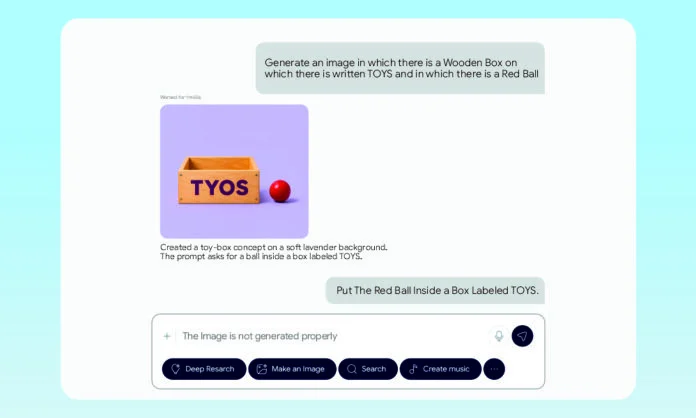
AI models have undoubtedly attained an edge across creative tasks like designing images and producing videos. However, there have been major concerns among users regarding AI image generation accuracy, especially in terms of text and object placement.
AI image generation has reached a new height in 2026, with every industry adopting the strategy to create still graphics faster and at scale. Sources state that over 34 million AI images are created daily in 2023. The usage has increased by 2.35x in 2026. So, it is understandable how remarkably organizations are using AI images.
However, AI models still have specific limitations, especially when it comes to maintaining accuracy in text and object placement. In this blog, we will understand why AI models fail to incorporate text and objects appropriately. Firstly, let us have a quick look at the emergence of AI image generation and usage.
The Emergence of AI Image Generation
A decade ago, when AI models were still in their early stages of development, few could have imagined generating multimedia content with nothing more than simple text prompts. However, this is now a reality, with millions of images, audio, and video generated with AI models daily. The journey started in the 1970s when the British artist Harold Cohen created AARON, the early pioneering autonomous computer art generation program.
The next wave came with the introduction of Generative Adversarial Networks (GANs) in 2014, which brought the idea of photorealistic image synthesis and style transfer in image generation. Then, in 2021, OpenAI introduced DALL-E and CLIP, which took the possibility of AI-generated images to the next level. The programs translated natural-language prompts into imagery directly.
Between 2022 and 2024, we observed mass consumer adoption of the concept of AI images and local open-source training. In this period, AI programs such as DALL-E 2 and Midjourney emerged. Today, AI image generators are working on character consistency, text rendering accuracy, and high-resolution output generation. The top AI models to create images in 2026 are Google Nano Banana, Midjourney, OpenAI’s ChatGPT, and Adobe Firefly.
Key AI Image Generation Accuracy Limitations
AI image generators have significantly advanced, but they still face challenges apart from image quality. These challenges become more remarkable when prompts require accuracy, consistency, and precise visual details. The major limitations that contribute to AI image generation accuracy struggles are:
- Inaccurate Text Rendering: AI models that generate images often add misspelled words, distorted characters, and inconsistent text usage. Additionally, they may also struggle while processing longer sentences, unusual fonts, and brand names.
- Incorrect Object Placement: Models can generate individual objects accurately but struggle to position them according to instructions. For example, a prompt might request a laptop beside a coffee mug. The generated image could place the mug behind the laptop instead.
- Inconsistent Object Proportions: AI models frequently find it difficult to maintain realistic ratios between different objects. A person might appear too large beside a vehicle, while furniture might have incorrect dimensions within a small room.
- Poor Spatial Relationships: Understanding spatial relationships involves more than identifying individual objects. In this regard, AI models must also determine how objects interact within a scene. However, instructions involving left, right, above, below, behind, and in front can produce unexpected results.
- Inconsistent Visual Composition: A detailed prompt may contain several objects, backgrounds, and positioning requirements. Models can overlook certain instructions while prioritizing others, which often results in missing elements, overlapping objects, or unbalanced compositions.
Why Do Models Struggle to Maintain AI Image Generation Accuracy?
Most text-to-image systems today use diffusion-based approaches that gradually transform random noise into images through repeated refinement. However, translating textual instructions into accurate visual elements involves several challenges. Below are the aspects that create barriers for AI models while maintaining accuracy in generated images:
- Text Processing Restrictions
Some image generators use text encoders to convert prompts to numerical representations. Some encoding techniques break words down into smaller pieces called tokens. This can sometimes make individual character sequences less accessible in image generation. So, models can reproduce familiar visual patterns but fail to spell unfamiliar words correctly.
- Limited spatial awareness
Knowing what things are does not mean you automatically know their relative places. An AI model may identify a table and chair but have difficulty placing them correctly. These elements also suggest the compositional difficulties with AI models.
- Complex Prompt Interpretation Difficulties
Multiple objects, attributes, and positioning requirements in text prompts increase the complexity of generation. On occasion, models may link descriptions to the wrong objects or forget certain instructions.
- Incomplete Training Information
Training AI models with images does not always include detailed descriptions of object positions, distances, and orientations. This limits the spatial information available during model training.
How Should AI Image Generators and Users Enhance Their Design Game?
Firstly, we have to understand that AI models have no idea about the real world and its objects. However, since they are trained on huge amounts of data, including text, images, and other formats with textual labels associated with images, AI models process text prompts and find relevance between the elements mentioned and the textual labels. So, being precise and direct with the prompts is a must. Additional strategies include,
Text Processing with Character Awareness
Character-aware encoders allow models to handle individual characters as well as the usual text representations, which can improve spelling accuracy when creating brand names, product labels, and signage. This is a common strategy used by models, but designers should constantly review and refine the output to make sure that it meets the creative and commercial standards.
Text Verification Using OCR
Optical Character Recognition (OCR) is able to recognize and extract text from generated images. The extracted text can be compared against the original prompt by the models to identify errors. It can help you catch mistakes, strip out text, regenerate layouts, and fix typos.
Layout Conditioning for Object Insertion
Layout conditioning gives extra spatial information during the image generation process, including bounding boxes, segmentation maps, and object layouts for developers. These references or examples guide the models to locate objects relative to pre-arranged layouts.
Cross-attention control
Cross-attention mechanisms try to find a link between textual instructions and visual regions. These attention maps can be used by researchers to improve object positioning and spatial alignment, and offer better control, without necessarily retraining the original model.
Visual Feedback and Iterative Refinement
Another approach to maintaining AI image generation accuracy involves generating an image, evaluating its output, and correcting identified problems. The strategy helps in evaluating rendered layouts and repeatedly adjusts them to improve readability and aesthetics across visual content.
Concluding Remarks!
AI models have surely empowered graphic designers and organizations with faster visual content creations, lower production costs, and seamless iteration. However, AI image generation accuracy is still a major concern for users. AI models surely cannot generate perfect images since they hallucinate and may introduce inaccurate, distorted, or entirely fabricated details that do not exist in reality.
Under such circumstances, text rendering, object placement, and composition remain important challenges. So, designers must be attentive while generating images with AI. Research into character-aware encoders, OCR verification, and spatial conditioning offers promising solutions in this regard.
Learn more about tech strategies and leading practices with YourTechDiet.
FAQs:
1. Are AI-generated images accurate?
Answer: AI-generated images are not reliably accurate even if they seem visually pleasing. AI models are prone to hallucinate and hence can depict real-world elements in misleading ways.
2. How to make AI-generated images look more realistic?
Answer: Write precise prompts describing real angles, natural lighting, and small imperfections instead of using trending and complex terms. Also, mention high resolution, the elements you want in the images, and that you require a realistic image. All these specifications in your prompt will help you generate realistic AI images.
3. Which AI image generators follow complex prompts most accurately?
Answer: Google’s Nano Banana series, OpenAI’s GPT Image 2, and Black Forest Labs’ FLUX.2 are among the leading AI image generators that follow complex prompts most accurately.
Also Read: