
Consider an enterprise with multiple business functions that rely on data to serve its customers, support daily operations, and make strategic decisions. Different business functions, including marketing, finance, operations, and sales, are responsible for generating and managing data related to their specific domain.
Since each department performs different business activities, it creates data with its own context, definitions, and requirements. Whenever a business domain needs access to data or requests a new dataset to build dashboards, generate analytics, or create data pipelines, it is routed to a central data engineering team. This central data engineering team handles hundreds of requests from other teams, and as a result, these requests start piling up, leading to longer turnaround times.
To overcome this hurdle, organizations started adopting data mesh architecture. This approach enables business domains to treat data as a product while decentralizing ownership. As a result, the teams that generate and understand the data are responsible for maintaining their quality, accessibility, and reliability. According to market projections, the data mesh market’s potential value is expected to reach USD 7.11 billion by 2034, up from USD 1.95 billion in 2026.
But is data mesh the right approach for every organization? Let us uncover in this blog…
What is Data Mesh Architecture?
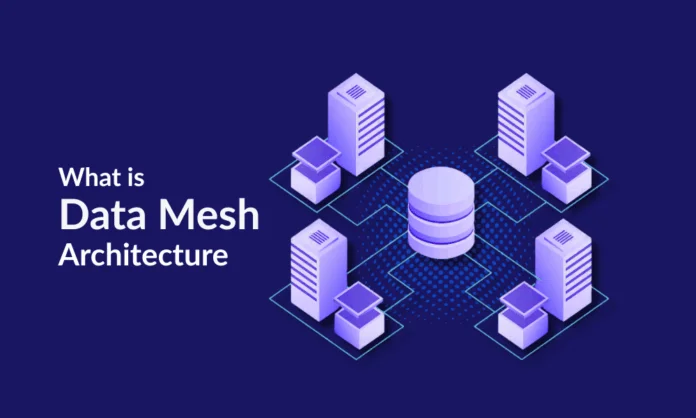
An architectural approach that decentralizes data ownership across business domains to enable faster access to trusted data is known as the data mesh architecture. It is designed to help organizations scale data management by allowing business domains to manage and share high-quality data.
Unlike traditional centralized data architectures, where data is stored and analyzed in a single data warehouse or data lake, data mesh distributes data ownership across business domains while treating data as a product.
Data stored in isolated systems can be difficult to integrate, limiting its value for advanced analytics, artificial intelligence, and big data initiatives.
This approach helps organizations manage growing data volumes systematically with shared governance. Data mesh supports four core principles that enable organizations to maintain data consistency, ensure well-governed data, and make data discoverable across business domains. IBM, SAP, Cinchy, Intenda, and NextData are among the leading players in the global data mesh industry.
Core Principles of Data Mesh
Data mesh changes how organizations manage enterprise data. A successful data mesh architecture is built on four core principles. These four core principles are as follows:
1. Domain Ownership
A domain is an area or department within an organization that performs a specific function. Each business domain has the deepest understanding of the data it generates and manages. In a data mesh, each domain is responsible for
- Collecting and managing the data.
- Maintaining metadata to improve data discovery and usability.
- Preparing and transforming data for reliable business use.
- Making data available to other teams whenever required.
The domain then treats its data as a product.
Example: Consider an e-commerce company with four business domains: sales, marketing, inventory, and customer support.
For example, the marketing team wants to measure how promotions affect sales. Instead of requesting data from a central data engineering team, it can directly access the sales dataset and combine it with its own campaign data. Similarly, the inventory team can use sales data to forecast stock requirements.
This enables faster analysis while keeping each business domain responsible for the quality and ownership of its own data.
2. Data-as-a-Product
The domain team ensures that its data products are reliable, discoverable, well-documented, and easy to access so that other business domains can easily discover and reuse them.
As a result, teams can confidently use data with less confusion and fewer dependencies on other business domains.
For example, the finance team publishes a well-documented revenue dataset that the sales and marketing teams can use directly without needing additional clarification.
3. Self-Service Data Infrastructure as a Platform
A self-service data platform provides domain teams with the tools they need to collect, store, process, and share data independently. Domain teams can manage their own data products and pipelines using a common platform.With automation and standardized tools, the platform makes data management easier without compromising consistency across the organization. As a result, the team can focus on providing reliable business insights rather than building and maintaining complex infrastructure.
For example, using a self-service data platform, the finance team can publish a monthly revenue dataset. The team can prepare, validate, and share data without creating its own infrastructure, making it easy for business domains to access trusted data whenever needed.
4. Federated Computational Governance
Maintaining consistent data governance is essential as data ownership is distributed across domains. Federated computational governance establishes shared policies, standards, and access controls across all business domains.
This principle helps maintain data quality, consistency, and compliance across the organization.
For example, a healthcare organization may allow different departments to manage their own patient data, but each department follows the same security policies to protect sensitive data.
Together, these four core principles enable organizations to build a scalable, decentralized, and well-governed data management framework.
Why Do Organizations Need Data Mesh Architecture?
Business operations slow down because the organization relies entirely on a single team to handle all data-related requests. Over time, the growing workload makes it harder for the central team to understand the context behind every request and deliver data on time. As a result, reports become inconsistent, and business decisions become inaccurate.
To address these challenges, organizations began adopting data mesh. As a single central data engineering team could no longer meet the needs of large organizations, this architecture distributes data ownership across business domains, allowing easier management, greater accuracy, and faster delivery, and enabling organizations to meet business needs more effectively.
Key Benefits of Data Mesh Architecture
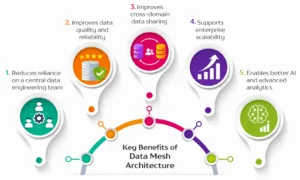
1. Reduces reliance on a central data engineering team
Instead of relying on a single central data engineering team for every data request, business teams can manage their own data. This eventually helps improve data access speed and reduces the time required for approval or support.
2. Improves data quality and reliability
Data quality is improved because each business domain owns and manages its data independently. As a result, data becomes more accurate, consistent, and trustworthy. Hence, domains can quickly correct errors, keep data up to date, and ensure it meets quality standards, making data more reliable for reporting and analytics.
3. Improves cross-domain data sharing
Data Mesh improves cross-domain data sharing. It allows business teams to access and use each other’s data easily. This data is available in standard formats so that any authorized team can quickly access the information they need.
4. Supports enterprise scalability
Data mesh supports enterprise scalability. As new domains or teams are added, they can manage their own data products without overloading the central data team. This makes it easy for the organization’s data system to grow as more teams, data, and applications are added, supporting long-term business growth.
5. Enables better AI and advanced analytics
Data Mesh provides better AI and advanced analytics by enabling each team to share its data as a well-managed data product. This enables AI and analytics tools to combine data from different business domains, helping organizations build more reliable AI models and generate more accurate insights and predictions.
Implementation Challenges of Data Mesh
1. Needs strong data governance
In a data mesh, although each domain manages its own data, it must follow common rules for naming, formatting, security, and quality. If these rules are not followed, data becomes inconsistent. It also becomes difficult for teams to share and use it.
2. Higher initial implementation effort
Initially, setting up a data mesh architecture requires significant time, planning, and changes to the organization’s way of working. Before teams can manage their own data, the company must reorganize responsibilities, create shared standards, and train each team. This makes the initial implementation more challenging than maintaining a traditional centralized data architecture.
3. Requires Data Literacy Across Teams
Data Mesh requires data literacy across teams because every department must understand how to manage and use data effectively. Teams need to understand how to organize data, maintain data quality, and use data tools properly. Without these skills, teams may create incorrect, incomplete, or inconsistent data. Without adequate data literacy, organizations may experience inconsistent data quality and governance.
Common Use Cases of Data Mesh Architecture
Data mesh is most effective in organizations that handle large volumes of data with multiple domains. Some common use cases are as follows:
1. Retail and E-commerce
Retail organizations manage data across sales, inventory, marketing, and customer service. Data mesh allows each business domain to manage its own data while making it available for analytics and demand forecasting.
2. Banking and Financial Services
The banking sector generates a large volume of data, including transactional, customer, and compliance data. Data mesh helps to maintain data ownership while supporting regulatory reporting, risk analysis, and fraud detection.
3. Healthcare
Healthcare providers generate data from departments such as patient care, laboratories, pharmacies, and billing. Data mesh allows these teams to manage trusted data while maintaining security and regulatory compliance.
Is Data Mesh Architecture the Right Choice for Your Organization?
Even though data mesh offers several advantages, it is not the right choice for every organization, as it also entails its own set of challenges.
The decision depends on factors such as the organization’s size, data complexity, business domains, and existing data management practices.
Data Mesh May Be the Right Choice If:
- Your organization has multiple business domains that generate a large volume of data.
- Teams frequently depend on a central data engineering team.
- You require faster access to trustworthy data for analytics.
Data Mesh May Not Be the Right Choice If:
- Your organization is small with simple data requirements.
- Most of the data is managed by a single team.
- The existing centralized data architecture already meets your business needs.
In Conclusion
Data mesh architecture enables a decentralized approach to managing enterprise data. It is particularly valuable for organizations with multiple business domains and growing data requirements. However, before adopting data mesh, organizations should evaluate their data maturity and operational complexities. When implemented with the right strategies, it can help build a scalable, reliable, and future-ready data ecosystem that supports better business decisions.
For more such updated information, visit our official website now!
FAQs
1. Can data mesh architecture be implemented without replacing the existing data system?
Answer: Adopting a data mesh does not require a complete system replacement. It can be adopted gradually by adding data ownership, governance, and domain-based management to existing systems.
2. Is data mesh suitable for cloud environments?
Answer: Yes, data mesh is commonly implemented with cloud environments because cloud platforms support scalable, flexible, and decentralized data management.
3. What technologies are commonly used to support data mesh?
Answer: Data mesh is not a single technology; it is an architectural approach that uses different tools to enable data ownership, sharing, governance, and analytics. Common technology categories include: Microsoft Azure, Google Cloud, Databricks, Apache Airflow, Snowflake, Tableau, Power BI.
Also Read:
Cloud Security Compliance with Types, Challenges, and Best Practices to Protect Your Data